Aarn is a world that has a 396.5 day year with five 79-80 day months in that year. According to the Zenninfal calendar, Aarn's months are further divided into 15 26-ish day "Constellations" or "Stars."
Depending on where one is in Zenninfal, Yessha and Habruk, the week is usually seven days long. The exception is Igakari and other isolated areas of Eastern Zenninfal, where the week is 11 days long, and the days are named after the eleven celestial bodies that wander Aarn's sky.
The Months and Seasons:
As an important astronomical disclaimer, Aarn's moon, Selmona, is actually a gas giant that orbits Aarn's sun, Vau. Aarn, in turn, orbits Selmona, so Aarn's year is actually Selmona's orbital period, and its months are Aarn's orbital period around Selmona.
Aarnians know this - they know that Selmona is a planet, and Aarn is a moon. Because Aarn's sister moons can be plainly seen orbiting Selmona, this knowledge was painfully obvious to even the earliest of Aarn's astronomers. But to make discussing Aarn's sky and culture easier, I call Selmona Aarn's "moon" because it is the primary object in Aarn's sky that waxes and wanes.
According to the Zeninfal calendar, each new year begins on the new moon following the winter solstice, which on average is 70 days after the solstice. The year can be divided into the four typical seasons, but instead of measuring the seasons via the equinoxes and solstices (which are still quite important to Aarn society), the seasons are measured by months.
Aarn's first month is considered spring, as the planet's northern hemisphere warms from winter. Its next two months are considered Summer and Midsummer, the periods of time when there are moderate to warm temperatures. Aarn's fourth month is considered Autumn, and Winter is Aarn's final month.
Importantly, there is no difference on Aarn between a solar month and a lunar month. Due to the peculiarities of Aarn's orbit, the yearly seasons stay in synch with the months, which always begin with a new moon, have a full moon in the middle of the month (when for a week the night is as nearly bright as a cloudy day) and a new moon again at the beginning of the next month. This is mostly what makes combining months with seasons possible.
Spring - 79 days on odd numbered years, and 80 days on even numbered years. The Spring Equinox usually takes place around the 30th of Spring.
Summer - 79 days. The Summer Solstice usually takes place around the 50th of Summer.
Midsummer - 80 days. The Midsummer Equinox usually takes place around the 70th of Midsummer.
Autumn - 79 days. Autumn has no equinox nor solstice.
Winter - 79 days. The Winter Solstice usually takes place around the 10th of Winter.
The Constellations:
Luckily for us Earthings, who happen to be used to thirty day months, Aarnians do use a unit of time of similar length - the "Constellations," or "Stars." Each month is divided up into 3 Constellations, roughly corresponding to the stars that Selmona crosses as it moves across Aarn's sky. These monthly constellations are named after objects or people that are culturally significant to the ancient Igans, but of course, there are far more constellations in the sky that are not directly associated with Aarn's calendar.
Spring -
The Fountain. Based on the legend of a miraculous fountain that provided a town with fresh water during a harsh winter when even the groundwater froze.
Lepis, The Hare. Based on the legend of a runner who was transformed by Venrisha into a rabbit.
The Rosary. According to legend, this constellation was put into the sky by a divine caster who threw her rosary into the heavens. According to conflicting accounts, it was put into the heavens in defiance of the gods, the gods put it there to shame her for her sacrifice, or the gods made it visible to all so she would never lose it again.
Summer -
The Rod. (Also known as The Scepter.) Some speculate that this constellation was once a fertility symbol in the sky, though modesty has shifted its original representation to one more suitable to polite company. It is now seen more as a sign of authority, and many mistakenly associate it with The Crown.
The Golem. A constellation that seems to be little more than a stick figure, but it has become associated with strength and magic, especially channeling. Other cultures associate this constellation with Giants, the forebears of most civilized races, in those cultures the constellation is only associated with strength, and not magic.
The Sea Turtle. According to an anicent myth, Aarn is borne by a sea turtle that swims the waters around Aarn's moon.
Midsummer -
The Tree. This constellation represents a World Tree that was said to support the heavens and connect them to Aarn.
The Cup. A vessel of flowing liquid, often associated with the brewing of ale and spirits.
Aran, The Warrior. A rival to one of Igakari's great ancient Heroes, Surmemnon. Few are sure why this constellation was named after Aran, and not Surmemnon, though some scholars believe that Aran was the original hero of the Surmemnonic epics, and historical revisonism took place some time in Igakari's history.
Autumn -
The Torch. A constellation said to symbolize the dwindling daylight hours, and also the importance of fire to many cultures and civilizations.
The Mill. A constellation whose origin can be traced back to satyrs, this constellation resembles a windmill, and is associated with strength, ingenuity and providing food for one's family.
Kyrie, The Bird. A harbinger of peace, also known for protecting wanderers and dreamers.
Winter -
The Silent King's Crown, also known as Rosenius' Crown, or more simply, just "The Crown." King Rosenius was an ancient, overweight ruler many consider to be fictional, but who may have been based on a real person. He is famous for taking a vow of silence after a great calamity befell his people, and then giving away much of his personal wealth.
The Wheel. A nearly circular constellation that resembles a spoked wheel. This constellation is associated with luck and fortune, both good and bad.
The Reaper. A cloaked figure, considered to be a servant of the One Mother (and her equivalents) who collects souls for the afterlife. He is considered a harbinger of the end of the year - and the start of the new.
The Days of the Week:
The areas conquered by the Jerol Empire (Eastern Zenninfal, Habruk, and Yeshha) share the same days of the week, separate from Igakari, which has an eleven day week (with the days named after the visible wandering celestial bodies in the Igan sky). When Habruk conqured the first Jerol tribes, the Jerolans were forced to give up their gods for Habrukan gods. They were allowed to keep their traditional seven day week, but the names of their traditional Ez gods were forcefully replaced by Habrukan gods. Since then, both Habruk and Yessha were conquered by the Jerol Empire, and the Jerol days of the week became canon for half of the world.
Onysday, the first day of the week, and day of renewal. Named after Onys, now known as the One Mother in Western Zenninfal, and Onyrsa in Habruk.
Junday, the day of productivity. Junhin was one of the few ethnic gods the Jerolans were allowed to keep, and as such, the invading Habrukan armies forced their Jerolan captives to work hard on the day of their god, in return for being allowed to keep him. Junhin would eventually become the modern Jennin, molded heavily by that forced work-ethic.
Stosday, the day of purification. This day was the day to cast out all influence from the god Stos, now known as Shtos in Habruk, and Nektos in Western Zenninfal.
Kensday, the day of power, and named after Kenkaran. Strangely, Kenkaran's name is still the same in Habruk today as it was three thousand years ago. Kenkaran eventually became Kennerin in Western Zenninfal.
Dirvsday, the day of reflection, named after Dirvas, the Habrukan Sky Father, god of rationality. Like Kenkaran, his name has changed little in three thousand years. Dirvas, a male, eventually became Western Zenninfal's Divianna, a female.
Fellsday, the day of pennance, named after the ancient god Fellis, who is now known as Fellys in Habruk, and Fagellis in Western Zenninfal. This was the day that all Jerolans were forced to participate in Habrukan religious ceremonies against their will. Themes of sin and self-hatred instilled in them by their Habrukan masters persist to this day.
Korsday, the day of celebration, named after the god Koris, who is now known as Korsan in Habruk, and Coralis in Western Zenninfal. Korsday was traditionally the day of feasting and rest, the one day the Jerolan tribe members were allowed to refresh themselves for the coming work week.
----
As a final astronomical side-note, an eclipse of the sun by Selmona lasts for more than 8 hours, with a total eclipse lasting for about half of that, far longer than the total eclipse of the sun by the moon on Earth. This length is due to the fact that from Aarn's perspective, Selmona is apparently larger than their sun. Selmona is so large that Vau's corona is usually not visible during the eclipse, though it is sometimes visible during the partial eclipse. Instead, what makes the eclipse spectacular is the huge black sphere in the sky, with Selmona's rings brightly illuminated on either side of it. Eclipse season happens at about twice a year, currently in late Spring and early Autumn, when Aarn's orbit intersects Selmona's shadow. The habitable side of Aarn is not always facing Selmona and the sun during that time.
Friday, May 15, 2009

Thursday, February 26, 2009
Aarn Timeline (Beginning with the Classical Era)
The Classical Era begins.
6200: The Ez spread north, Conquering Igakari and much of the Yesshan trade route. The Sphinxes come out of hiding, and begin secretly protecting human towns and settlements.
6250: The Anthromorph race of cursed humans becomes culturally accepted in Western Zenninfal and Yessha. In retaliation, Venrisha creates the theromorph race of cursed godtouched in Eastern Zenninfal.
6275: The channeler kings of Rensvaja resurface. Out of self-preservation and cultural honor, they limit themselves to 30 members in a soul link, and no more, and divide their ruling class into many, many separate sub-nations, each with its own link.
Year 6300: The nation of Igakari is founded when the enslaved Igan race of humans asserts its own legitimacy, rebelling against the Ez and breaking free of their control.
6400: Igakari begins dominating its region, conquering Kressia, The Southern Way, and much of Camaria. Rothysia is claimed, but in name only, as it could not be captured.
6500: The Ez experience an age of enlightenment. Their technological and magical discoveries are deemed too dangerous, and kept secret from the world.
6700: The Lenneshin in Khodosan enter a truce with the Yak farmers there. The Lenneshin handle magical needs, the Yak farmers physical. This relationship remains stable until the present day.
6600: The Ez and the Rensvaja kings go to war over the fertile lands south of the Yesshan desert, once claimed by the Valdrex. The Rensvaja kings win the conflict.
6800: The Camarian War of Independence succeeds, and Camaria becomes a sovereign nation, breaking off from Igakari. It experiences a series of ceaseless, bloody civil wars that last for three hundred years.
6900: The Ez civilization collapses from Naga invasion, and its knowledge of magic is lost with it.
7000: Habrukans invade and conquer the Hightrade rim and central Zenninfal, forming the short-lived Third Habrukan Empire.
7050: The Camarian Orthodox Church is formed as a method to control the masses. It works, and Camaria remains relatively stable for a thousand years, save repeated maritime conflicts with Igakari.
7100: The Valdrex awaken from their stasis and begin settling in northwestern Rensvan. After reclaiming their lands from the northern Rensvaja kings and southern Naga, they passively begin trading with the other races, and enslaving those who attempt to attack them. Modern Valdrex foreign policy is born.
7270: The Jerolans drive their Habrukan masters out of Western Zenninfal.
7300: The Jerolans conquer The Hightrade Rim, then proceed to conquer, over a period of 40 years, all of Western Zenninfal and Habruk. The Jerolans' easterly advance is only halted by the barbarians of Rothysia, who are deemed too costly to fight past.
7310: The official 'Year 0' Date of the Jerol Empire. All Jerol-speaking nations use this date to begin their calendars.
7390: A group of proud warriors from Treddis rebell against the Jerol Empire, freeing the island from Jerol control.
7400: The Jerol Empire seeds Treddis with creeper vine in retaliation for its rebellion.. The entire island is soon overrun with undead things. Nektos turns Treddis into his base of operations.
7500: The first Jerolan civil war occurs between two brothers, Cassis Helnin III and Farnorn Helnin for control of the Empire. The civil war continues for long after the two brothers are dead.
7600: The First Jerolan civil war is resolved by the last of the great Jerolan Emperors, Gaelnorn Weis, who ushers in Jerol's second Golden Age. Gealnorn Weis begins to conquer the Yesshan Trade Route, and the begins conquering what little remains of the Ez. The Jerolan Empire reaches its largest size.
7630: Gaelnorn Weis dies. His sons begin to mismanage and mangle the Empire.
7640: Magical Rebellion occurs in the province of Querris, near Lake Anessis. The Rebellion is put down, but not without high cost. Magic is deemed too important to the Jerolan Empire to be left up to chance, and the practice of wizardry is banned, except by Emperor's decree.
7700: The society of the Jerolan empire becomes bloated, hedonistic, shortsighted and incompetent. The empire nearly collapses on numerous occasions.
7790: The Great Igan Revolution occurs. Feudal peasants, lead by a charismatic Lightning Channeler, rebel against the channeling Aristocracy of Igakari. Most channelers are forced to flee the country. An anti-mage sentiment begins to brew in the nation, coupled with anti-intellectualism. Many great works and educational material are lost.
7800: Through a series of misadventures and implausible events, the exiled aristocracy of Igakari form “The Elementalist Guilds” in the Jerol Empire and begin helping Jerol even more strictly control the magic of its citizens.
7900: The Elementalist Golden Age. All children of channeling potential are drafted by the Elementalist Guilds. The guilds themselves assume political control over the entire Empire, and the Emperor becomes a figurehead. The culture and language of Igakari becomes seen as “noble” in the Jerol Empire because of the guilds.
7912: The Jerol Empire invades Igakari from Habruk, bypassing Rothysia altogether. The forces of armored knights lead by channelers conquer Kressia and begin marching on Igakari proper from the north.
7914: Northern Igakari is temporarily occupied by Jerol Empire forces. These forces are driven out by a combination of mundane guerilla fighters on the Igan side, and a temporary truce between the Igans and the Barbarians of Rothysia, who come to their aid.
7916: Igakari reclaims Kressia from the Jerolan Empire. Jerol barters a truce with Igakari before the Igan and Rothysian forces have a chance to begin liberating parts of Habruk.
7937: A nameless Igakari Biomancer develops the Hull Tree, a biomantic technology that allows farmers to literally grow the hulls of ships and boats. Many thought the influx of new ships would help Igakari's economy and navy grow to unprecedented levels. Instead, the new invention prompts an economic collapse as it is adopted too quickly, and thousands of shipwrights are put out of business.
7957: The continuing economic crisis forces Igakari to cut its budget. It frees the lands of Kressia and the Southern Way to become self-governing and autonomous. The Kressian populace returns to a city-state level of politics, which they continue to maintain until the present with varying levels of succeess. The Southern Way degrades into a lawless state of anarchy, barely more civilized than the Barbarians of Rothysia, with fewer morals. Trade with Yessha becomes impossible over land.
7963: The last Emperor of the Jerolan Empire, Claus Weis II, dies. The office of Emperor is retired, the Jerolan Empire's leadership finally replaced with an oligarchy of the Elementalist Guild leaders.
8000: Anthromorph people begin migrating to Zhanpai, where they are brutally discriminated against. The first “Campaign of Human Purity” begins in Shoyu. There are several more of these campaigns in Shoyu and Goxian over the next several hundred years.
8018: The Southern Way begins to tame itself. Those along the banks of the Lyban river begin to allow trade caravans to pass again, destroying the Empire's monopoly on the trade of Yesshan goods, further harming its superpower status. Igakari begins to recover from its economic crisis.
8069: The Jerolan empire begins to lose control of the borderlands. Uprisings begin to tear the northern empire apart, especially in Habruk, Tehgrahan and Aesinra. Pockets of rogue, bandit nations begin to form.
8085: Bandit raids on many of the Empire's key economic cities, lead especially by a bandit known only as “The White Wraith of the West,” help bankrupt the nation. The Elementalist guilds begin to fight with one another for power.
8093: The Empire loses control of Aesinra.
8116: The Empire loses control of the Hightrade Rim
8122: The Second Jerolan Civil War begins between the final surviving Elementalist guilds. The war lasts a full two generations.
8138: The Empire loses control of Habruk. The Surviving members of the Sky Tribe are exiled from Kuulainen.
8140: The Empire loses control of Tehgrahan.
8150: The Igakari nation recovers from its anti-intellectualism and anti-mage sentiment in the face of invasion from Habrukans, culturally angry that Igakari chose not to help liberate them from the Jerolan Empire a century and a half before. In order to drive back the inland raiders and their divine magic, Igakari begins to develop enhanced methods of enchantment and wizardry.
8167: Archibald Crossduke is born. Julius Cerenbaun is born.
8180: The Igakari Golden Age of Peace and Prosperity begins as the Habrukan raids stop.
8189: The Jerol Empire officially collapses as the Necromancers and Biomancers of the Elementalist guild fight to the death outside Kaola. The Five Years of Chaos begins as the remaining Empire falls and fractures.
8192: The nation of Jerohm stabilizes in northern Yessha, continuing the traditions of the Jerol Empire, and asserting authoritative control over the Yesshan trade route.
8194: The Five Years of Chaos end, when Julius Cerenbaun takes control of the city of Jerol and successfully defends it from recently liberated Habrukan barbarians. He quickly leads a campaign to reclaim Shanbar and Querris, and unites them with Denenga into the nation of Cerenbaun. Afterwards, the King continues to ride through Jerolan lands, attempting to reclaim them under his banner.
8195: Archibald Crossduke officially becomes the court wizard of Cerenbaun, a position he continues to hold today.
8197: A lich loyal to Nektos becomes queen of Treddis
8199: Igakari sends a delegation of wizards to Cerenban, including the Fuchsia Immortal, in order to convince the king to not attempt to rebuild the Jerolan empire. The Igan delegation is at first rebuked. The King vanishes that night, and remains missing for two and a half months. When he returns, he has mysteriously agreed to the Igans' terms, and liberates all provinces but Querris, Denenga and Shanbar from his control.
The Classical Era ends. The Age of Magic begins.
8200: Platemail becomes obsolete as the general populace begins to learn how to cast wizardry. The influence of channelers over political discourse in both Igakari and Cerenbaun reduces dramatically. Anthromorphs become culturally accepted in Khodosan.
8221: The Magitech Revolution begins when an animancer named Armond Danzer announces to the world that he has discovered how to weave multiple spell effects into the same enchantment. He is found dead under mysterious circumstances 3 days later.
8222: Wands are invented, as well as other magical devices that can be activated by conscious thought. Swordplay enters a fencing age.
8231: The principles behind the Aledoran Soul Core are rediscovered. For the first time in thousands of years, non-elemancers find themselves able to command elementals.
8248: The Wizard's Council is founded.
8272: Cerenbaun business interests muscle out Jehrom interests from the Yesshan trade route, and slowly begin taking authoritative control, beginning with Treddis and the islands that separate the Sea of Lost Souls from the Sunless Sea.
8276: Archibald Crossduke becomes the first modern cybermancer, shedding his mortal body, and having his soul leap between his golems. In the process, he invents the ability to activate spells with other spells and mechanical devices, rather than aural manipulation and command words. The knowledge of how to do this helps elevate Cerenbaun to superpower status.
8310: Igakari begins to enter a decline, as the nation refuses to expand its territory or ideas.
8325: Elemancers revolutionize their craft by inventing constructs. Biomancers and necromancers are unimpressed.
8341: The first proper airship is invented by Archibald Crossduke, using lighter-than-air gasses to supplement levitation and control spells.
8367: The Ardlin godtouched race is created.
8371: Igakari's decline arguably worsens as it adopts an “Open border” policy. Further, all barbarians from Rothysia are to be treated with the rights of full citizens.
8378: Marcello Jeobardi invents the Jeobardi flier. His pterodactyl design, requiring a soul core to operate properly, does not catch on outside of Animancer circles, though it would have otherwise revolutionized air travel.
8384: The first modular golemnoth is invented, and begins patrolling the streets of Jerol.
8390: (Spring) The Possessions RP begins.
8391: The One Mother's presence vanishes. Spirit Animal solidarity fractures. Many spirit animals begin revealing themselves to other races in both friendly and unfriendly ways.
8392: The number of followers of The One Mother drops off rapidly. The goddess Raphalla begins to be worshiped as the goddess of life and fertility. Nature cults begin to worship Venrisha in droves. Death cults begin to pray to Nektos.
8397: Igakari stabilizes as its ruling body of scholars is replaced in a bloodless coup by a council of representative magistrates of Igakari's cities. Despite keeping Igakari's open border policy, the Magistrate council begins to colonize the Eastern Islands as a source for wealth, compromising Igakari's peaceful ideals, but saving the nation. Hasperia is founded.
8428: The First Railgate Station links Gaerman in Cerenbaun with the port city of Aldzan in Jehrom. It's creator, Zel Manzeen, becomes instantly world famous. Several assassination attempts are made on his life, but he survives.
8434: The First Railgate Station Network is constructed in the cities of Jerol, Austor and Montall, linking Cerenbaun's three capitols together. Cerenbaun's economic and productive capacity almost doubles overnight.
8436: (Summer) The Three Months War takes place. Cerenbaun invades the border lands of Gaelda with 30 Golemnoths, ostensibly to destroy bandits that Gaelda authorities refused to prosecute. Igakari condemns the action. War between the two superpowers is narrowly averted.
8439: The One Mother's presence returns. Spirit Animals begin to become xenophobic and unfriendly. The Worshipers of the One Mother begin treating her as if she is the goddess of death, and not life and death.
8440: (Spring) The Aarn 2 RP begins.
8440: Cerenbaun and Igakari draw up a treaty to allow certain border cities of Cerenbaun to be Railgate-linked to border cities in Igakari, allowing the two superpowers to more easily trade with one another. The treaty is hailed as ushering in a new era of peace and prosperity for all of Zenninfal.
8440: (Fall) The Aarn Adventures RP begins
8441: The One Mother and Nektos have a much publicized battle near the southeastern shore of Lake Anessis. For the first time in recorded history, 349 divine casters combine their efforts to cast a single ritual spell through dancing and singing. The goddess Reksha seems to be summoned by the ritual, who then puts a stop to the battle between Nektos and the One Mother. There is a sudden surge in the popularity of Reksha's cults.
8443: The year that will be considered “The present” for when/if Aarn is ever published as a game setting.
6200: The Ez spread north, Conquering Igakari and much of the Yesshan trade route. The Sphinxes come out of hiding, and begin secretly protecting human towns and settlements.
6250: The Anthromorph race of cursed humans becomes culturally accepted in Western Zenninfal and Yessha. In retaliation, Venrisha creates the theromorph race of cursed godtouched in Eastern Zenninfal.
6275: The channeler kings of Rensvaja resurface. Out of self-preservation and cultural honor, they limit themselves to 30 members in a soul link, and no more, and divide their ruling class into many, many separate sub-nations, each with its own link.
Year 6300: The nation of Igakari is founded when the enslaved Igan race of humans asserts its own legitimacy, rebelling against the Ez and breaking free of their control.
6400: Igakari begins dominating its region, conquering Kressia, The Southern Way, and much of Camaria. Rothysia is claimed, but in name only, as it could not be captured.
6500: The Ez experience an age of enlightenment. Their technological and magical discoveries are deemed too dangerous, and kept secret from the world.
6700: The Lenneshin in Khodosan enter a truce with the Yak farmers there. The Lenneshin handle magical needs, the Yak farmers physical. This relationship remains stable until the present day.
6600: The Ez and the Rensvaja kings go to war over the fertile lands south of the Yesshan desert, once claimed by the Valdrex. The Rensvaja kings win the conflict.
6800: The Camarian War of Independence succeeds, and Camaria becomes a sovereign nation, breaking off from Igakari. It experiences a series of ceaseless, bloody civil wars that last for three hundred years.
6900: The Ez civilization collapses from Naga invasion, and its knowledge of magic is lost with it.
7000: Habrukans invade and conquer the Hightrade rim and central Zenninfal, forming the short-lived Third Habrukan Empire.
7050: The Camarian Orthodox Church is formed as a method to control the masses. It works, and Camaria remains relatively stable for a thousand years, save repeated maritime conflicts with Igakari.
7100: The Valdrex awaken from their stasis and begin settling in northwestern Rensvan. After reclaiming their lands from the northern Rensvaja kings and southern Naga, they passively begin trading with the other races, and enslaving those who attempt to attack them. Modern Valdrex foreign policy is born.
7270: The Jerolans drive their Habrukan masters out of Western Zenninfal.
7300: The Jerolans conquer The Hightrade Rim, then proceed to conquer, over a period of 40 years, all of Western Zenninfal and Habruk. The Jerolans' easterly advance is only halted by the barbarians of Rothysia, who are deemed too costly to fight past.
7310: The official 'Year 0' Date of the Jerol Empire. All Jerol-speaking nations use this date to begin their calendars.
7390: A group of proud warriors from Treddis rebell against the Jerol Empire, freeing the island from Jerol control.
7400: The Jerol Empire seeds Treddis with creeper vine in retaliation for its rebellion.. The entire island is soon overrun with undead things. Nektos turns Treddis into his base of operations.
7500: The first Jerolan civil war occurs between two brothers, Cassis Helnin III and Farnorn Helnin for control of the Empire. The civil war continues for long after the two brothers are dead.
7600: The First Jerolan civil war is resolved by the last of the great Jerolan Emperors, Gaelnorn Weis, who ushers in Jerol's second Golden Age. Gealnorn Weis begins to conquer the Yesshan Trade Route, and the begins conquering what little remains of the Ez. The Jerolan Empire reaches its largest size.
7630: Gaelnorn Weis dies. His sons begin to mismanage and mangle the Empire.
7640: Magical Rebellion occurs in the province of Querris, near Lake Anessis. The Rebellion is put down, but not without high cost. Magic is deemed too important to the Jerolan Empire to be left up to chance, and the practice of wizardry is banned, except by Emperor's decree.
7700: The society of the Jerolan empire becomes bloated, hedonistic, shortsighted and incompetent. The empire nearly collapses on numerous occasions.
7790: The Great Igan Revolution occurs. Feudal peasants, lead by a charismatic Lightning Channeler, rebel against the channeling Aristocracy of Igakari. Most channelers are forced to flee the country. An anti-mage sentiment begins to brew in the nation, coupled with anti-intellectualism. Many great works and educational material are lost.
7800: Through a series of misadventures and implausible events, the exiled aristocracy of Igakari form “The Elementalist Guilds” in the Jerol Empire and begin helping Jerol even more strictly control the magic of its citizens.
7900: The Elementalist Golden Age. All children of channeling potential are drafted by the Elementalist Guilds. The guilds themselves assume political control over the entire Empire, and the Emperor becomes a figurehead. The culture and language of Igakari becomes seen as “noble” in the Jerol Empire because of the guilds.
7912: The Jerol Empire invades Igakari from Habruk, bypassing Rothysia altogether. The forces of armored knights lead by channelers conquer Kressia and begin marching on Igakari proper from the north.
7914: Northern Igakari is temporarily occupied by Jerol Empire forces. These forces are driven out by a combination of mundane guerilla fighters on the Igan side, and a temporary truce between the Igans and the Barbarians of Rothysia, who come to their aid.
7916: Igakari reclaims Kressia from the Jerolan Empire. Jerol barters a truce with Igakari before the Igan and Rothysian forces have a chance to begin liberating parts of Habruk.
7937: A nameless Igakari Biomancer develops the Hull Tree, a biomantic technology that allows farmers to literally grow the hulls of ships and boats. Many thought the influx of new ships would help Igakari's economy and navy grow to unprecedented levels. Instead, the new invention prompts an economic collapse as it is adopted too quickly, and thousands of shipwrights are put out of business.
7957: The continuing economic crisis forces Igakari to cut its budget. It frees the lands of Kressia and the Southern Way to become self-governing and autonomous. The Kressian populace returns to a city-state level of politics, which they continue to maintain until the present with varying levels of succeess. The Southern Way degrades into a lawless state of anarchy, barely more civilized than the Barbarians of Rothysia, with fewer morals. Trade with Yessha becomes impossible over land.
7963: The last Emperor of the Jerolan Empire, Claus Weis II, dies. The office of Emperor is retired, the Jerolan Empire's leadership finally replaced with an oligarchy of the Elementalist Guild leaders.
8000: Anthromorph people begin migrating to Zhanpai, where they are brutally discriminated against. The first “Campaign of Human Purity” begins in Shoyu. There are several more of these campaigns in Shoyu and Goxian over the next several hundred years.
8018: The Southern Way begins to tame itself. Those along the banks of the Lyban river begin to allow trade caravans to pass again, destroying the Empire's monopoly on the trade of Yesshan goods, further harming its superpower status. Igakari begins to recover from its economic crisis.
8069: The Jerolan empire begins to lose control of the borderlands. Uprisings begin to tear the northern empire apart, especially in Habruk, Tehgrahan and Aesinra. Pockets of rogue, bandit nations begin to form.
8085: Bandit raids on many of the Empire's key economic cities, lead especially by a bandit known only as “The White Wraith of the West,” help bankrupt the nation. The Elementalist guilds begin to fight with one another for power.
8093: The Empire loses control of Aesinra.
8116: The Empire loses control of the Hightrade Rim
8122: The Second Jerolan Civil War begins between the final surviving Elementalist guilds. The war lasts a full two generations.
8138: The Empire loses control of Habruk. The Surviving members of the Sky Tribe are exiled from Kuulainen.
8140: The Empire loses control of Tehgrahan.
8150: The Igakari nation recovers from its anti-intellectualism and anti-mage sentiment in the face of invasion from Habrukans, culturally angry that Igakari chose not to help liberate them from the Jerolan Empire a century and a half before. In order to drive back the inland raiders and their divine magic, Igakari begins to develop enhanced methods of enchantment and wizardry.
8167: Archibald Crossduke is born. Julius Cerenbaun is born.
8180: The Igakari Golden Age of Peace and Prosperity begins as the Habrukan raids stop.
8189: The Jerol Empire officially collapses as the Necromancers and Biomancers of the Elementalist guild fight to the death outside Kaola. The Five Years of Chaos begins as the remaining Empire falls and fractures.
8192: The nation of Jerohm stabilizes in northern Yessha, continuing the traditions of the Jerol Empire, and asserting authoritative control over the Yesshan trade route.
8194: The Five Years of Chaos end, when Julius Cerenbaun takes control of the city of Jerol and successfully defends it from recently liberated Habrukan barbarians. He quickly leads a campaign to reclaim Shanbar and Querris, and unites them with Denenga into the nation of Cerenbaun. Afterwards, the King continues to ride through Jerolan lands, attempting to reclaim them under his banner.
8195: Archibald Crossduke officially becomes the court wizard of Cerenbaun, a position he continues to hold today.
8197: A lich loyal to Nektos becomes queen of Treddis
8199: Igakari sends a delegation of wizards to Cerenban, including the Fuchsia Immortal, in order to convince the king to not attempt to rebuild the Jerolan empire. The Igan delegation is at first rebuked. The King vanishes that night, and remains missing for two and a half months. When he returns, he has mysteriously agreed to the Igans' terms, and liberates all provinces but Querris, Denenga and Shanbar from his control.
The Classical Era ends. The Age of Magic begins.
8200: Platemail becomes obsolete as the general populace begins to learn how to cast wizardry. The influence of channelers over political discourse in both Igakari and Cerenbaun reduces dramatically. Anthromorphs become culturally accepted in Khodosan.
8221: The Magitech Revolution begins when an animancer named Armond Danzer announces to the world that he has discovered how to weave multiple spell effects into the same enchantment. He is found dead under mysterious circumstances 3 days later.
8222: Wands are invented, as well as other magical devices that can be activated by conscious thought. Swordplay enters a fencing age.
8231: The principles behind the Aledoran Soul Core are rediscovered. For the first time in thousands of years, non-elemancers find themselves able to command elementals.
8248: The Wizard's Council is founded.
8272: Cerenbaun business interests muscle out Jehrom interests from the Yesshan trade route, and slowly begin taking authoritative control, beginning with Treddis and the islands that separate the Sea of Lost Souls from the Sunless Sea.
8276: Archibald Crossduke becomes the first modern cybermancer, shedding his mortal body, and having his soul leap between his golems. In the process, he invents the ability to activate spells with other spells and mechanical devices, rather than aural manipulation and command words. The knowledge of how to do this helps elevate Cerenbaun to superpower status.
8310: Igakari begins to enter a decline, as the nation refuses to expand its territory or ideas.
8325: Elemancers revolutionize their craft by inventing constructs. Biomancers and necromancers are unimpressed.
8341: The first proper airship is invented by Archibald Crossduke, using lighter-than-air gasses to supplement levitation and control spells.
8367: The Ardlin godtouched race is created.
8371: Igakari's decline arguably worsens as it adopts an “Open border” policy. Further, all barbarians from Rothysia are to be treated with the rights of full citizens.
8378: Marcello Jeobardi invents the Jeobardi flier. His pterodactyl design, requiring a soul core to operate properly, does not catch on outside of Animancer circles, though it would have otherwise revolutionized air travel.
8384: The first modular golemnoth is invented, and begins patrolling the streets of Jerol.
8390: (Spring) The Possessions RP begins.
8391: The One Mother's presence vanishes. Spirit Animal solidarity fractures. Many spirit animals begin revealing themselves to other races in both friendly and unfriendly ways.
8392: The number of followers of The One Mother drops off rapidly. The goddess Raphalla begins to be worshiped as the goddess of life and fertility. Nature cults begin to worship Venrisha in droves. Death cults begin to pray to Nektos.
8397: Igakari stabilizes as its ruling body of scholars is replaced in a bloodless coup by a council of representative magistrates of Igakari's cities. Despite keeping Igakari's open border policy, the Magistrate council begins to colonize the Eastern Islands as a source for wealth, compromising Igakari's peaceful ideals, but saving the nation. Hasperia is founded.
8428: The First Railgate Station links Gaerman in Cerenbaun with the port city of Aldzan in Jehrom. It's creator, Zel Manzeen, becomes instantly world famous. Several assassination attempts are made on his life, but he survives.
8434: The First Railgate Station Network is constructed in the cities of Jerol, Austor and Montall, linking Cerenbaun's three capitols together. Cerenbaun's economic and productive capacity almost doubles overnight.
8436: (Summer) The Three Months War takes place. Cerenbaun invades the border lands of Gaelda with 30 Golemnoths, ostensibly to destroy bandits that Gaelda authorities refused to prosecute. Igakari condemns the action. War between the two superpowers is narrowly averted.
8439: The One Mother's presence returns. Spirit Animals begin to become xenophobic and unfriendly. The Worshipers of the One Mother begin treating her as if she is the goddess of death, and not life and death.
8440: (Spring) The Aarn 2 RP begins.
8440: Cerenbaun and Igakari draw up a treaty to allow certain border cities of Cerenbaun to be Railgate-linked to border cities in Igakari, allowing the two superpowers to more easily trade with one another. The treaty is hailed as ushering in a new era of peace and prosperity for all of Zenninfal.
8440: (Fall) The Aarn Adventures RP begins
8441: The One Mother and Nektos have a much publicized battle near the southeastern shore of Lake Anessis. For the first time in recorded history, 349 divine casters combine their efforts to cast a single ritual spell through dancing and singing. The goddess Reksha seems to be summoned by the ritual, who then puts a stop to the battle between Nektos and the One Mother. There is a sudden surge in the popularity of Reksha's cults.
8443: The year that will be considered “The present” for when/if Aarn is ever published as a game setting.
Aarn Timeline (Beginning with the Era of Lies)
The "Demonic Era," also known as "The Era of Lies" begins.
1600: Demons begin settling in Aarn, building their own cities, especially in Yessha and Western Zenninfal. The Demons name their cities in what will become Shanbar after the countries of Europe.
1700: The Merfolk begin gathering up in the Great Barrier Sea, fleeing the highly volcanic waters of the Eastern Islands. They abandon wizardry and begin developing biotechnology, choosing to shun magic.
1850: A combination of Demons being corrupted by power and Humans learning of religious dogma cause the Humans to start to worship Demons as gods.
2000: Aledoran remnants interbreeding with Udhan give rise to what will become the Yesshan race.
2100: The Tehxiona of Kuulainen begin sending emissaries into the world, teaching the old ways, and revealing how the Demon information about the afterlife is a “lie.” Horrible religious wars break out, with demon technology making these wars brutal and devastating.
2531: The Fey put their foot down and exile the demons off of Aarn, forever. This leaves behind backwards, technologically incompetent civilizations of all races who allow their religious fervor to rule themselves.
The “Era of Lies” ends. “The Age of Legends” begins.
2600: The Tehxiona, the only godtouched race with surviving technological base, begin conquering the continent, subjugating the other godtouched races, like the Aledorans before them. The Udhan in Rensvaja enter a long period of extended barbarism.
2850: A pollitical upheaval in the Tehxiona leadership causes much of their technological security to be compromised. Tehxiona devices and education start to become controlled by other races.
2900: The area that will become the Chianmos Desert, the major linking hub between the Eastern and Western Tehxiona empire, and the source of much of its food, begins to drought. The Tehxiona to the east begin interbreeding with Aledoran remndants, giving rise to the Zhan race.
2940: The Valdrex awaken from their extended hibernation. They begin to quietly manipulate events in Yessha, wishing the world to think they are extinct.
3000: A centaur empire begins forming in the Eastern Islands. They exilie all Aledoran remnants to the mainland.
3100: The Yun empire, humans secretly controlled and manipulated by the Valdrex, overthrow their Tehxiona masters in Yessha.
3300: The Yun begin conquering Camaria, driving out or killing the non-Yesshan populace. The drought in what will become the Chianmos desert worsens. A pollitical schism occurs in the Tehxiona empire, where the eastern and western areas of the empire are to be controlled by separate pollitical factions.
3320: The Yun conquer what will become Igakari, effectively separating the Eastern and Western Tehxiona empires further. Attempts to invade Rothysia result in stalemate with the Ghrok living there.
3450: The Yun begin conquering the islands that will become the Yesshan trade route, an area effectively ignored by the Tehxiona empire.
3455: The Yun launch a surprise invasion of Western Zenninfal from Treddis. The Western Tehxiona Empire falls back to Habruk, suing for peace. The ancestors of the Rothysian barbarians are cut off from the rest of Tehxiona and begin to integrate with the Ghrok. The Yun liberate the Satyrs, who teach the Yun advanced methods of agriculture. The Yun and Centaur empire ally with one another.
3500: Interbreeding between the Yun and Tehxiona give rise to the ancestors of the Jerolan people. An Era of protracted cold war between the Yun and Eastern Tehxiona begins
3900: Valdrex Wizards rediscover how to create and manipulate channeler portals. A vast network of gates is set up between the important parts of the Yun Empire. Cultural backlash between rapidly homogenizing cultural areas almost tears the empire apart. Eastern Tehxiona loses its superpower status in an economic collapse.
4000: A Lenneshin uprising in Zhanpai drives the humans out of the eastern Eifalos mountains.
4100: The Yun civil war ends, and Yun enters its golden age. Constant border conflicts arise between the Yun and the Rothysian barbarians. The Barbarians are never conquered, but this war helps to energize the Yun economy. Desertification begins to take hold in the already arid and overfarmed central Yessha.
4300: A large group of Naga attack Yessha, discovering that the Valdrex are still alive and controlling the Yun. They ally themselves with the harpies in the north, and use the Yuns' own portal gates to organize simultaneous strikes halfway across the world.
4350: The Yesshan desert nears its current size. The Yun depend on magics to keep it fertile and producing food. Naga rebels destroy these magical devices and a worldwide famine begins.
4400: The Lenneshin spread east, into the Khodosan valley. The Great Lenneshin Revival takes place.
4500: The Yun empire fractures. Their homogenous culture begins to degrade as barbarian and naga invasion brings Western Zenninfal and Yessha into a dark ages. The Valdrex retreat south, and begin conquering Rensvan and the barbarian Uhdan.
4600: The Zhan Empire is founded in Zhanpai, and begins conquering the Eastern Islands. A long protracted war between the Centaurs and the mainlanders begins.
4650: Satyrs in Western Zenninfal attempt to preserve knowledge despite the current dark ages, with the secret aid of spirit animals. Vizdane orders the Spirit animals to reveal their secret knowledge to the world. They abandon him, murder the Satyrs and begin following Venrisha. They actively work against any new civilizations that try to form in Western Zenninfal.
4700: The Centaurs invade Zhanpai, and begin setting up mainland colonies. At the same time, the Zhan Empire presses west, driving the Lenneshin in Khodosan underground.
4800: The Spirit Animals manage to completely destroy what remains of civilized harpies. They become animalistic, preying on human males to propogate their species. The Spirit Animals consider this a great success, but are rebuked by Venrisha who prefers perversion rather than complete destruction. She abandons the Spirit animals, and they are adopted by the One Mother.
4900: Remnants of the Yun empire rename themselves the Kamar empire, and conquer all of Camaria, Igakari and much of the Eastern islands. The Centaur empire finally collapses, and Centaurs revert to barbarism.
5000: A series of brutal four-way wars over what will become Igakari take place between the Kamar, the Habrukans, Rothysian Ghrok and the Zhan. Kamar retains control of the land, but interbreeding between the three human groups has created the precursor for the Igan race.
5100: Venrisha creates the anthromorph race of cursed humans. They are hunted by civilized races out of superstition and fear.
5200: Nektos successfully creates sentient undead. He rapidly begins spreading the undeath virus all over Aarn. Kamar loses control over the Eastern Islands.
The Age of Legends ends. The Era of Death begins.
5300: The Kamar remnants in the Eastern Islands are duped into believing that all tall people are secretly vampires in disguise. The average height of humans in the Eastern Islands plummets.
5600: The Zhan empire attempts to fight back the undead plague by creating their own magical plague, engineered to destroy those infected with undeath. This plague backfires horribly, killing anyone who has ever come into physical contact with an undead specimen. The Ghrok and Centaurs are almost driven to extinction. World population plummets. Nektos isolates his favorite species of undead in order to preserve them and releace them again once the plague has run its course. The Valdrex, once again, put themselves into a stasis.
5650: With the disappearance of their masters, the Rensvaja people (formerly the Uhdon) begin discovering the secrets of wizardry. Out of desperation, they form massive soul links with one another to resist the undead hordes.
5690: The first Rensvaja soul-linked channeler king rises to power.
5700: The Zhan empire fractures into the separate civilizations of Khodosan, Goxian and Shaoyu. As the Plague was created by magic, the Zhan culture chooses to brand magic as sinful.
5800: The last remnants of the Kamar empire revert to tribalism in the face of extinction.
6000: The Ez civilization begins to rise in Yessha, insulated from the global plague by the great heat and arid conditions.
6090: The largest soul-link in history, of 561 individuals, all die at once, plunging Rensvan into a time of chaos and strife, despite surviving much of the plague and undead invasion.
6100: The Great Plague finally ends, with the numbers of surviving Undead and Godtouched races pulled down to pathetic population levels. Much technological and magical knowledge is lost.
The Era of Death ends. The Classical Era begins.
1600: Demons begin settling in Aarn, building their own cities, especially in Yessha and Western Zenninfal. The Demons name their cities in what will become Shanbar after the countries of Europe.
1700: The Merfolk begin gathering up in the Great Barrier Sea, fleeing the highly volcanic waters of the Eastern Islands. They abandon wizardry and begin developing biotechnology, choosing to shun magic.
1850: A combination of Demons being corrupted by power and Humans learning of religious dogma cause the Humans to start to worship Demons as gods.
2000: Aledoran remnants interbreeding with Udhan give rise to what will become the Yesshan race.
2100: The Tehxiona of Kuulainen begin sending emissaries into the world, teaching the old ways, and revealing how the Demon information about the afterlife is a “lie.” Horrible religious wars break out, with demon technology making these wars brutal and devastating.
2531: The Fey put their foot down and exile the demons off of Aarn, forever. This leaves behind backwards, technologically incompetent civilizations of all races who allow their religious fervor to rule themselves.
The “Era of Lies” ends. “The Age of Legends” begins.
2600: The Tehxiona, the only godtouched race with surviving technological base, begin conquering the continent, subjugating the other godtouched races, like the Aledorans before them. The Udhan in Rensvaja enter a long period of extended barbarism.
2850: A pollitical upheaval in the Tehxiona leadership causes much of their technological security to be compromised. Tehxiona devices and education start to become controlled by other races.
2900: The area that will become the Chianmos Desert, the major linking hub between the Eastern and Western Tehxiona empire, and the source of much of its food, begins to drought. The Tehxiona to the east begin interbreeding with Aledoran remndants, giving rise to the Zhan race.
2940: The Valdrex awaken from their extended hibernation. They begin to quietly manipulate events in Yessha, wishing the world to think they are extinct.
3000: A centaur empire begins forming in the Eastern Islands. They exilie all Aledoran remnants to the mainland.
3100: The Yun empire, humans secretly controlled and manipulated by the Valdrex, overthrow their Tehxiona masters in Yessha.
3300: The Yun begin conquering Camaria, driving out or killing the non-Yesshan populace. The drought in what will become the Chianmos desert worsens. A pollitical schism occurs in the Tehxiona empire, where the eastern and western areas of the empire are to be controlled by separate pollitical factions.
3320: The Yun conquer what will become Igakari, effectively separating the Eastern and Western Tehxiona empires further. Attempts to invade Rothysia result in stalemate with the Ghrok living there.
3450: The Yun begin conquering the islands that will become the Yesshan trade route, an area effectively ignored by the Tehxiona empire.
3455: The Yun launch a surprise invasion of Western Zenninfal from Treddis. The Western Tehxiona Empire falls back to Habruk, suing for peace. The ancestors of the Rothysian barbarians are cut off from the rest of Tehxiona and begin to integrate with the Ghrok. The Yun liberate the Satyrs, who teach the Yun advanced methods of agriculture. The Yun and Centaur empire ally with one another.
3500: Interbreeding between the Yun and Tehxiona give rise to the ancestors of the Jerolan people. An Era of protracted cold war between the Yun and Eastern Tehxiona begins
3900: Valdrex Wizards rediscover how to create and manipulate channeler portals. A vast network of gates is set up between the important parts of the Yun Empire. Cultural backlash between rapidly homogenizing cultural areas almost tears the empire apart. Eastern Tehxiona loses its superpower status in an economic collapse.
4000: A Lenneshin uprising in Zhanpai drives the humans out of the eastern Eifalos mountains.
4100: The Yun civil war ends, and Yun enters its golden age. Constant border conflicts arise between the Yun and the Rothysian barbarians. The Barbarians are never conquered, but this war helps to energize the Yun economy. Desertification begins to take hold in the already arid and overfarmed central Yessha.
4300: A large group of Naga attack Yessha, discovering that the Valdrex are still alive and controlling the Yun. They ally themselves with the harpies in the north, and use the Yuns' own portal gates to organize simultaneous strikes halfway across the world.
4350: The Yesshan desert nears its current size. The Yun depend on magics to keep it fertile and producing food. Naga rebels destroy these magical devices and a worldwide famine begins.
4400: The Lenneshin spread east, into the Khodosan valley. The Great Lenneshin Revival takes place.
4500: The Yun empire fractures. Their homogenous culture begins to degrade as barbarian and naga invasion brings Western Zenninfal and Yessha into a dark ages. The Valdrex retreat south, and begin conquering Rensvan and the barbarian Uhdan.
4600: The Zhan Empire is founded in Zhanpai, and begins conquering the Eastern Islands. A long protracted war between the Centaurs and the mainlanders begins.
4650: Satyrs in Western Zenninfal attempt to preserve knowledge despite the current dark ages, with the secret aid of spirit animals. Vizdane orders the Spirit animals to reveal their secret knowledge to the world. They abandon him, murder the Satyrs and begin following Venrisha. They actively work against any new civilizations that try to form in Western Zenninfal.
4700: The Centaurs invade Zhanpai, and begin setting up mainland colonies. At the same time, the Zhan Empire presses west, driving the Lenneshin in Khodosan underground.
4800: The Spirit Animals manage to completely destroy what remains of civilized harpies. They become animalistic, preying on human males to propogate their species. The Spirit Animals consider this a great success, but are rebuked by Venrisha who prefers perversion rather than complete destruction. She abandons the Spirit animals, and they are adopted by the One Mother.
4900: Remnants of the Yun empire rename themselves the Kamar empire, and conquer all of Camaria, Igakari and much of the Eastern islands. The Centaur empire finally collapses, and Centaurs revert to barbarism.
5000: A series of brutal four-way wars over what will become Igakari take place between the Kamar, the Habrukans, Rothysian Ghrok and the Zhan. Kamar retains control of the land, but interbreeding between the three human groups has created the precursor for the Igan race.
5100: Venrisha creates the anthromorph race of cursed humans. They are hunted by civilized races out of superstition and fear.
5200: Nektos successfully creates sentient undead. He rapidly begins spreading the undeath virus all over Aarn. Kamar loses control over the Eastern Islands.
The Age of Legends ends. The Era of Death begins.
5300: The Kamar remnants in the Eastern Islands are duped into believing that all tall people are secretly vampires in disguise. The average height of humans in the Eastern Islands plummets.
5600: The Zhan empire attempts to fight back the undead plague by creating their own magical plague, engineered to destroy those infected with undeath. This plague backfires horribly, killing anyone who has ever come into physical contact with an undead specimen. The Ghrok and Centaurs are almost driven to extinction. World population plummets. Nektos isolates his favorite species of undead in order to preserve them and releace them again once the plague has run its course. The Valdrex, once again, put themselves into a stasis.
5650: With the disappearance of their masters, the Rensvaja people (formerly the Uhdon) begin discovering the secrets of wizardry. Out of desperation, they form massive soul links with one another to resist the undead hordes.
5690: The first Rensvaja soul-linked channeler king rises to power.
5700: The Zhan empire fractures into the separate civilizations of Khodosan, Goxian and Shaoyu. As the Plague was created by magic, the Zhan culture chooses to brand magic as sinful.
5800: The last remnants of the Kamar empire revert to tribalism in the face of extinction.
6000: The Ez civilization begins to rise in Yessha, insulated from the global plague by the great heat and arid conditions.
6090: The largest soul-link in history, of 561 individuals, all die at once, plunging Rensvan into a time of chaos and strife, despite surviving much of the plague and undead invasion.
6100: The Great Plague finally ends, with the numbers of surviving Undead and Godtouched races pulled down to pathetic population levels. Much technological and magical knowledge is lost.
The Era of Death ends. The Classical Era begins.
Tuesday, February 24, 2009
On defining characteristics
Once upon a time, Aarn was a fantasy setting that was largely defined by what it was not. It was not a setting where the gods had anything to do with the afterlife. It was not a setting where a wizard's magic was amorphous and poorly understood. It was not a setting that involved those silly alignments. It was not a setting where magic failed to influence industry. It was not a setting where magic was separate from nature, or where its connection to mortals was left unexplained.
This trend was largely because, as a fan of fantasy, I designed Aarn by examining my favorite sorts of fantasy stories, then taking out or subverting what I didn't like about them. Aarn quickly ballooned into the sort of setting that I, personally, would love. But over the year and a half I have spent working on it, it's been hard to sell to people.
When you define something negatively, it becomes difficult to summarize in an attractive way. What makes it special doesn't sound so special, because you're forced to reference other works. In short, despite the content I've created, Aarn had very few defining characteristics it could call its own, that I could use to get strangers excited about the setting.
On that note, I've decided that the setting as a whole is mature enough for me to start to take more risks in its design. Sure, Aarn's demons are non-magical, science-fiction enhanced weirdos dressed up like 1940s America, and Aarn's afterlife is like few others, but the setting as a whole needs more than that to carry it.
So one of my new design goals is to take Aarn's magic and Aarn's society, then think about what sorts of unique, eye-catching and interesting technologies and cultures might develop. In some respects, trying to push the envelope with what can be done with Aarn's technology is something I should have done from the beginning, but better late than never, right?
Some of the things I've come up with are as follows:
Livestock that have been biomantically engineered to be much bigger than their Earthly counterparts. Hogs the size of cows, Chickens the size of ostriches, etc.
Cows that have been biomantically bred to brew beer, ale, spirits and wine in their udders, completely self-contained.
Trees that have been biomantically engineered to grow into the hulls for boats, ships and airships, allowing large and flexible navies to be grown, instead of built.
Necromancers and Death Channelers make excellent cooks, food preparers, and nutritionists. As those who become experienced in death channeling magic begin to naturally mummify, there is a high turnover and high demand for this field of work.
Towers built to impossible heights by, every 30 stories, creating a portal on the top of each support column that leads to the ground, somewhere out in the woods, distributing the weight of the building.
Shipping large amounts of illicit cargo by smuggling it in the pocketspaces of crowds of people crammed onto boats and airships.
Large guilds and organizations run by channelers for various industries. For instance, Earth, Metal and Water channeler bricklayers, road pavers and miners, working very efficiently, and very quickly, compared to non-magical infrastructure.
Wizard sweatshops, where low level wizards are forced to enchant random brick-a-brac all day long.
Railgate Networks: Imagine a train station, only on either end of each track is a large magitech ring instead of more track. This ring can be attuned to various other rings on various other stations in various other cities, in order to form an instant portal network between these stations. These stations are used to transport cargo primarily, though people can pay a premium. Many cities do not want to make emigration into or out of the city so cheap or easy, so ticket prices are artificially inflated. Military-Industrial railgate stations can also connect mines and lumberyards with blacksmith shops and animancer workshops, and can be transported by a strike team deep within enemy territory, where large armies can be brought in overnight. The railgate networks as a whole are a new technology, which are threatening the economic stability of shipping trade, caravan trade and airship trade, introducing an era of corporate espionage.
Large cities with intra-city gate systems, similar to the railgate network, causing a huge, sprawling “small town” area to have the economy and education level of an legitimate city because of quick access to the important public buildings.
Huge golems that patrol the streets of large cities, with massive tanks of water on their backs. Using channeling abilities, the golems use tendrils made of the water to put out fires, clean streets, clean windows and building walls, and help with the construction and repair of buildings.. These golems also act as an impromptu police and military response units.
Hovering slabs of metal that float on top of city streets, and are propelled either by force spells or propellers. Or even by kicking. (Hover scooters anyone?)
An international banking network run by magic, where anyone with a bank stamp can access their account from any affiliate bank in any nation. It is perhaps the formation of this banking system soon after the fall of the Jerol Empire that kept the world from plunging into a dark ages.
Aarn's chief military powers are known to use the corpses of giant sea turtles as the basic frames for their oceangoing siege vessels.
There are wand turrets with giant roating frames filled with many wands, allowing the turret to sling more than one spell every 3-6 seconds. Some animancers are attempting to adopt this technology for hand-held wands.
Religious ideas that are wrong -despite- proof of souls, gods, and an afterlife. Education is poor in Aarn's rural areas, and religious, faithful people are distrustful of verificationism. That and the reality (an afterlife where no gods are involved, at all, and there are only hells and no heavens) is one many religious people would choose to refuse to face. This one is perhaps too realistic for fantasy, but I do enjoy that it's in the system.
Magical Pollution, akin to light pollution in large cities. Those who live in highly industrialized, magitech cities have noticed that using aura-detection gear causes mild headaches because everything magical is so bright and tightly clustered together. Further, inanimate things that normally shouldn't have magic defenses tend to develop them if left in a highly industrialized city for too long.
This trend was largely because, as a fan of fantasy, I designed Aarn by examining my favorite sorts of fantasy stories, then taking out or subverting what I didn't like about them. Aarn quickly ballooned into the sort of setting that I, personally, would love. But over the year and a half I have spent working on it, it's been hard to sell to people.
When you define something negatively, it becomes difficult to summarize in an attractive way. What makes it special doesn't sound so special, because you're forced to reference other works. In short, despite the content I've created, Aarn had very few defining characteristics it could call its own, that I could use to get strangers excited about the setting.
On that note, I've decided that the setting as a whole is mature enough for me to start to take more risks in its design. Sure, Aarn's demons are non-magical, science-fiction enhanced weirdos dressed up like 1940s America, and Aarn's afterlife is like few others, but the setting as a whole needs more than that to carry it.
So one of my new design goals is to take Aarn's magic and Aarn's society, then think about what sorts of unique, eye-catching and interesting technologies and cultures might develop. In some respects, trying to push the envelope with what can be done with Aarn's technology is something I should have done from the beginning, but better late than never, right?
Some of the things I've come up with are as follows:
Livestock that have been biomantically engineered to be much bigger than their Earthly counterparts. Hogs the size of cows, Chickens the size of ostriches, etc.
Cows that have been biomantically bred to brew beer, ale, spirits and wine in their udders, completely self-contained.
Trees that have been biomantically engineered to grow into the hulls for boats, ships and airships, allowing large and flexible navies to be grown, instead of built.
Necromancers and Death Channelers make excellent cooks, food preparers, and nutritionists. As those who become experienced in death channeling magic begin to naturally mummify, there is a high turnover and high demand for this field of work.
Towers built to impossible heights by, every 30 stories, creating a portal on the top of each support column that leads to the ground, somewhere out in the woods, distributing the weight of the building.
Shipping large amounts of illicit cargo by smuggling it in the pocketspaces of crowds of people crammed onto boats and airships.
Large guilds and organizations run by channelers for various industries. For instance, Earth, Metal and Water channeler bricklayers, road pavers and miners, working very efficiently, and very quickly, compared to non-magical infrastructure.
Wizard sweatshops, where low level wizards are forced to enchant random brick-a-brac all day long.
Railgate Networks: Imagine a train station, only on either end of each track is a large magitech ring instead of more track. This ring can be attuned to various other rings on various other stations in various other cities, in order to form an instant portal network between these stations. These stations are used to transport cargo primarily, though people can pay a premium. Many cities do not want to make emigration into or out of the city so cheap or easy, so ticket prices are artificially inflated. Military-Industrial railgate stations can also connect mines and lumberyards with blacksmith shops and animancer workshops, and can be transported by a strike team deep within enemy territory, where large armies can be brought in overnight. The railgate networks as a whole are a new technology, which are threatening the economic stability of shipping trade, caravan trade and airship trade, introducing an era of corporate espionage.
Large cities with intra-city gate systems, similar to the railgate network, causing a huge, sprawling “small town” area to have the economy and education level of an legitimate city because of quick access to the important public buildings.
Huge golems that patrol the streets of large cities, with massive tanks of water on their backs. Using channeling abilities, the golems use tendrils made of the water to put out fires, clean streets, clean windows and building walls, and help with the construction and repair of buildings.. These golems also act as an impromptu police and military response units.
Hovering slabs of metal that float on top of city streets, and are propelled either by force spells or propellers. Or even by kicking. (Hover scooters anyone?)
An international banking network run by magic, where anyone with a bank stamp can access their account from any affiliate bank in any nation. It is perhaps the formation of this banking system soon after the fall of the Jerol Empire that kept the world from plunging into a dark ages.
Aarn's chief military powers are known to use the corpses of giant sea turtles as the basic frames for their oceangoing siege vessels.
There are wand turrets with giant roating frames filled with many wands, allowing the turret to sling more than one spell every 3-6 seconds. Some animancers are attempting to adopt this technology for hand-held wands.
Religious ideas that are wrong -despite- proof of souls, gods, and an afterlife. Education is poor in Aarn's rural areas, and religious, faithful people are distrustful of verificationism. That and the reality (an afterlife where no gods are involved, at all, and there are only hells and no heavens) is one many religious people would choose to refuse to face. This one is perhaps too realistic for fantasy, but I do enjoy that it's in the system.
Magical Pollution, akin to light pollution in large cities. Those who live in highly industrialized, magitech cities have noticed that using aura-detection gear causes mild headaches because everything magical is so bright and tightly clustered together. Further, inanimate things that normally shouldn't have magic defenses tend to develop them if left in a highly industrialized city for too long.
Thursday, November 27, 2008
Birthdays
I turned 25 on monday, and today the blog turns a full year old. So, happy birthday, Aarn! Have some cute.


Thursday, November 20, 2008
Magic: More than you ever needed to know about Wizards
The process of writing the last post helped me understand Aarnian magic, but it also raised some questions, when I considered some of the logical implications of my rules. One of these questions was: "Why don't wizards explode?"
Despite the amusing mental image, it's a serious question. I try to force Aarn's magic (at the very least, its wizardry magic) to follow the law of conservation of energy. Like solar radiation, the energy that fuels magic bombards Aarn from the Astral Sea. Once a magical spell is prepared in the material world (or so I wanted my rules to state) its energy must be expressed -somehow-, or canceled out by other magic.
So this brought me to the question of why a staff releases its magical energy when broken, but a wizard does not. Obviously, I do like the idea of wizards exploding like staves, but if this were true of Aarn, the entire civilization I've built would have developed differently. Science and knowledge would be mistrusted, and Aarn would be far more like a traditional fantasy setting where wizards are mistrusted and banished from reasonable civilization, with good reason. And that sort of setting is boring and overplayed.
Eventually I decided that because wizards have souls, the spells are attached to those souls and not their physical bodies. Otherwise a wizard's spell would discharge whenever they break an arm or get ripped in half. (Hey, it happens.) But this still raises the question of why a wizard doesn't explode when he dies, and his soul goes through the trauma of death, or when a soul-linked animal dies, with similar results.
What I eventually managed to decide (with some help) was that wizards don't explode because the spell energy follows the soul into the inbetween, and then the astral sea. If a wizard dies, there is indeed an explosion of magical energy, but it takes place in an area where only ghosts and astral channelers will be affected. Perhaps some strange magical effects will persist in an area (such as all the physical objects in a certain radius sharing the ex-wizard's spell resistance) but for the most part, no truly visible effect will happen, while preserving the law of conservation of energy.
Of course, once in one of the nine hells, all bets are off for what happens. For a long while, I wanted wizards to lose their spells when their astral body was destroyed and forced to reform in the afterlife. If they did this, they would either have to explode, or the hells themselves would have to do something with the energy. I'm not so fond of the second solution (I try to avoid deus ex machinas) but I haven't decided quite how to handle it yet. I hadn't thought of making the afterlife so different from Aarn that wizards were outcasts due to their exploding when killed, and I'm still not sure if I like the idea or not. It might explain why the afterlife's technology hasn't progressed beyond Aarn's, though, and then again there's the hilarity of exploding wizards running around everywhere. It's made funnier in a setting where no one can be permanently killed.
As for Aarn itself, I think some justification is needed for why wizards are tolerated in society even if they -don't- explode. A wizard has far more power available to him or her than the average town guard, and it would be far too easy for a wizard to abuse the system and also Aarn's populace.
The simple solution is that wizards are self-policing. The spells in the first 6 tiers of spell levels are more or less as powerful as channeling can get without overchanneling. After that, wizards become exponentially more powerful. A single level 12 spell (the most powerful spellweaves can get) can wipe out a town with one blast. Even without a tenancy to explode, wizards are quite literally walking bombs, if they were to bring all their energy to bare.
In order to help ensure that civilization proceeds without self-destructing, the wizards from taking everything over, or the leaders of communities don't abuse their wizards, wizards themselves have entered into an agreement of mutually assured destruction called the "Wizards Council." The council was probably formed as the result of some long past war of wizards that destroyed civilization. (Again. Probably happened 3000 years ago.) The Council itself is made up of the 40 most powerful wizards alive. Membership is not optional, and there is no way to opt-out. If any wizard gets too big for his or her britches (even a member of the council), the council is there to smack them down and put them in their place.
In practice, the council has not worked as well as in theory. Civilization is still stable, though, so the council must be doing something right. Even if it -is- constantly back-stabbing itself, conspiring against itself, and overlooking the more powerful displays of magic when they occur. The wizard's council has been less about mutually assured destruction, and more about nursing the egos of wizards to keep them under control, while also acting as a public relations department to keep giant displays of magic tolerable by the greater populace.
Wizardry is more or less Aarn's version of nuclear engineering. Like nuclear engineering, wizardy is very dangerous when performed by amateurs, tolerated because it helps to further society, and rarely used to its fullest potential because everyone understands that such a release of energy would be against humankind's collective best interest. The kingdoms and nations of Aarn understand that any level 10 and up spells used in an act of war would effectively destroy whatever goal they had in starting that war, and likely destroy themselves in the process.
The analogy is not perfect however. Nuclear engineers don't confine their experiments to towers for fear of explosions killing pedestrians. There are far fewer nukes on earth than wizards on Aarn. Our nukes are also not self-aware, nor can they decide to set themselves off on a whim.
Wizardry's volatility is perhaps yet another reason for why Aarn's world population is so low. The Wizard's Council, instead of preventing destruction, may simply be used as fodder for the following argument: "Hey, we should tolerate wizards despite all that death and property destruction. Imagine how much worse things would be -without- the Council, and in the meantime, wizardry has given us so many wonderful technological advances."
So naturally, while I love the idea of a wizard spontaneously combusting, if it was commonplace, SWC (spontaneous wizard combustion) would destabilize an already unstable situation. Granted, I can't let such a hilarious idea go to waste, so there will of course be very powerful spells that can cause a wizard to completely discharge all their spell energy. Wizards do still explode occasionally on Aarn. They just don't -always- explode at death.
Despite the amusing mental image, it's a serious question. I try to force Aarn's magic (at the very least, its wizardry magic) to follow the law of conservation of energy. Like solar radiation, the energy that fuels magic bombards Aarn from the Astral Sea. Once a magical spell is prepared in the material world (or so I wanted my rules to state) its energy must be expressed -somehow-, or canceled out by other magic.
So this brought me to the question of why a staff releases its magical energy when broken, but a wizard does not. Obviously, I do like the idea of wizards exploding like staves, but if this were true of Aarn, the entire civilization I've built would have developed differently. Science and knowledge would be mistrusted, and Aarn would be far more like a traditional fantasy setting where wizards are mistrusted and banished from reasonable civilization, with good reason. And that sort of setting is boring and overplayed.
Eventually I decided that because wizards have souls, the spells are attached to those souls and not their physical bodies. Otherwise a wizard's spell would discharge whenever they break an arm or get ripped in half. (Hey, it happens.) But this still raises the question of why a wizard doesn't explode when he dies, and his soul goes through the trauma of death, or when a soul-linked animal dies, with similar results.
What I eventually managed to decide (with some help) was that wizards don't explode because the spell energy follows the soul into the inbetween, and then the astral sea. If a wizard dies, there is indeed an explosion of magical energy, but it takes place in an area where only ghosts and astral channelers will be affected. Perhaps some strange magical effects will persist in an area (such as all the physical objects in a certain radius sharing the ex-wizard's spell resistance) but for the most part, no truly visible effect will happen, while preserving the law of conservation of energy.
Of course, once in one of the nine hells, all bets are off for what happens. For a long while, I wanted wizards to lose their spells when their astral body was destroyed and forced to reform in the afterlife. If they did this, they would either have to explode, or the hells themselves would have to do something with the energy. I'm not so fond of the second solution (I try to avoid deus ex machinas) but I haven't decided quite how to handle it yet. I hadn't thought of making the afterlife so different from Aarn that wizards were outcasts due to their exploding when killed, and I'm still not sure if I like the idea or not. It might explain why the afterlife's technology hasn't progressed beyond Aarn's, though, and then again there's the hilarity of exploding wizards running around everywhere. It's made funnier in a setting where no one can be permanently killed.
As for Aarn itself, I think some justification is needed for why wizards are tolerated in society even if they -don't- explode. A wizard has far more power available to him or her than the average town guard, and it would be far too easy for a wizard to abuse the system and also Aarn's populace.
The simple solution is that wizards are self-policing. The spells in the first 6 tiers of spell levels are more or less as powerful as channeling can get without overchanneling. After that, wizards become exponentially more powerful. A single level 12 spell (the most powerful spellweaves can get) can wipe out a town with one blast. Even without a tenancy to explode, wizards are quite literally walking bombs, if they were to bring all their energy to bare.
In order to help ensure that civilization proceeds without self-destructing, the wizards from taking everything over, or the leaders of communities don't abuse their wizards, wizards themselves have entered into an agreement of mutually assured destruction called the "Wizards Council." The council was probably formed as the result of some long past war of wizards that destroyed civilization. (Again. Probably happened 3000 years ago.) The Council itself is made up of the 40 most powerful wizards alive. Membership is not optional, and there is no way to opt-out. If any wizard gets too big for his or her britches (even a member of the council), the council is there to smack them down and put them in their place.
In practice, the council has not worked as well as in theory. Civilization is still stable, though, so the council must be doing something right. Even if it -is- constantly back-stabbing itself, conspiring against itself, and overlooking the more powerful displays of magic when they occur. The wizard's council has been less about mutually assured destruction, and more about nursing the egos of wizards to keep them under control, while also acting as a public relations department to keep giant displays of magic tolerable by the greater populace.
Wizardry is more or less Aarn's version of nuclear engineering. Like nuclear engineering, wizardy is very dangerous when performed by amateurs, tolerated because it helps to further society, and rarely used to its fullest potential because everyone understands that such a release of energy would be against humankind's collective best interest. The kingdoms and nations of Aarn understand that any level 10 and up spells used in an act of war would effectively destroy whatever goal they had in starting that war, and likely destroy themselves in the process.
The analogy is not perfect however. Nuclear engineers don't confine their experiments to towers for fear of explosions killing pedestrians. There are far fewer nukes on earth than wizards on Aarn. Our nukes are also not self-aware, nor can they decide to set themselves off on a whim.
Wizardry's volatility is perhaps yet another reason for why Aarn's world population is so low. The Wizard's Council, instead of preventing destruction, may simply be used as fodder for the following argument: "Hey, we should tolerate wizards despite all that death and property destruction. Imagine how much worse things would be -without- the Council, and in the meantime, wizardry has given us so many wonderful technological advances."
So naturally, while I love the idea of a wizard spontaneously combusting, if it was commonplace, SWC (spontaneous wizard combustion) would destabilize an already unstable situation. Granted, I can't let such a hilarious idea go to waste, so there will of course be very powerful spells that can cause a wizard to completely discharge all their spell energy. Wizards do still explode occasionally on Aarn. They just don't -always- explode at death.
Magic: Contramagery
By popular demand, this post is going to be a basic rundown of what happens when magical effects end, and how to cause such ends to happen artificially. This post is going to be filled to the brim with jargon, so proceed at your own risk!
As a refresher, these are all the different types of magic that exist on Aarn:
Spellweaves: A spell that either is an instant effect or has a timed duration, controlled and produced by wizards.
Manifestations: A spell that either is an instant effect or has a timed duration, controlled and expressed by divine casters.
Channeling: Raw magical energy directed by the intuitive will of a godtouched creature.
Infusions: The essence of a spellweave or a manifestation permanently bound to an object, which leaches magical fuel from the surrounding aether. Cannot be used on godtouched creatures, because the natural magical energy flowing in and around their bodies disrupts such magic.
Soul Links, Soul Bonds, and Soul Divisions: Semi-permanent effects that bend the rules of magic, blurring the lines between spellweaves, manifestations and channeling. These effects can provide semi-permanent magical abilities and traits not otherwise possible.
Potions: A deliberately unstable infusion of water, that is designed to release its infused effect when the water is scattered, metabolized, or absorbed through other means.
Boons: A type of manifestation that is a permanent effect granted to a godtouched creature.
Runecrafts: The raw "language" of magic, which provides a simple, yet semi-permanent effect borrowed from the channeling magic system to an object, animal or godtouched.
Spellrunes: Runes that are designed to release a single spellweave or manifestation effect, once, destroying/damaging whatever they are inscribed upon in the process.
Further, there are a number of different sorts of spell effects which can be produced using the above methods of magical casting.
Physical effects: Whenever a spell causes damage indirectly with a physical object, this is considered a physical effect. An example of a physical effect is lifting up a rock and telekinetically flinging it at a target. The telekinetic spell could in theory be dispelled, but the rock cannot, neither can the wound caused by the rock.
Semi-illusory effects: Most common in channeling and manifesting (wizards have great difficulty reproducing these effects because spellweaves cannot provide the intuitive manual control needed), semi-illusory effects include the processes of transmutation, liquification and solidification. When an object has changed its shape through these means, it stores a sort of magical "memory" of what it used to be for 1-2 months. After this period of time, the change becomes permanent and can no longer be dispelled, but during this time, a dispell effect will try to restore the object's original shape.
Instant effects: An instant effect is a spell effect such as a fireball or ray of energy, that only persists for a very short period of time. These effects do not have a duration, and the results of these effects cannot be dispelled, though the energy itself can be dispelled if the character doing the dispelling has very quick reflexes.
Persistant effects: Any spell effect with a duration is considered a persistant effect. These are spell effects that provide some change to something in the environment that requires a constant supply of magic. Once the supply of magic provided with the spell is extinguished, the effect ends. The effect can be prematurely ended through dispelling.
Most channeler abilities that need to be maintained by a constant amount of energy (read, everything except for the physical results of shaping) are considered persistent effects, though a channeler can always provide more energy and restart the effect if it is dispelled.
Enchantment: Any spell effect that is semi-permanent but not illusory is considered an enchantment. Most enchantments can be dispelled, though soul-related magic and boons repair themselves over time. Enchantments, despite being a type of magic, can produce their own secondary magical effects. When a wand fires an instant effect at a target, there are two magical effects in play, the instant effect itself, and the enchantment that grants the wand the ability to unleash the instant effect.
Of course, with so many types of spells, there's more than one way of getting rid of their effects. Primarily, divine casters and channelers focus on magic that protects against effects, and wizards tamper with the magic itself, removing the effect, though wizards also have access to protective spells
Spell Resistance: As stated above, all godtouched creatures (and most monsters) have turbulent magical energy flowing through them, whether they are a mage or not. This energy not only prevents godtouched creatures from normally being subject to permanent spell effects, but it can also block impermanent effects as well. Any mage must take spell resistance into account, because spells will affect a godtouched creature much less severely than an animal or an inanimate object. Inanimate objects that have infusions, runes or are potions also have spell resistance.
Barriers: The simplest method of blocking magical energy is a shield or barrier. These types of protection do not do much to the magical energy. Instead, barriers replace the energy's intended target with themselves. If a barrier is not sufficient to block all of the magical energy subjected to it at once, the barrier will usually be destroyed, and the rest of the energy will affect its intended target. Some more advanced barriers will simply buckle and fold, allowing the excess energy through, then re-form themselves. Barriers can protect against all different types of magical effects.
Reflection: Whenever a barrier has the ability to redirect a spell effect away from itself, the barrier is said to be a reflection effect. Reflection effects, like other sorts of barriers, can only redirect so much energy before buckling and failing. Basic reflection spells simply rebound magical energy in the direction it came from.
Advanced reflection effects can redirect magical energy in any direction the caster chooses. Still more advanced reflection effects can temporarily store magical energy that hits it. The person in control of the reflection effect can then release the energy at a time and direction of the caster's choosing. The more powerful the reflection effect, the longer the caster can wait before releasing the energy.
Reflection effects do not change anything about the fundamental nature of the spell energy they redirect, other than its direction. Reflection effects do not protect against indirect physical effects from magic. They also have difficulty protecting against enhanced objects or physical strikes that have been imbued with magical energy, like a sword that is on fire, or a punch enveloped by swirling winds.
Nullification: Nullification effects, such as "Dispell" spells, are one of the most common forms of magical defense. These effects overwhelm magical energy, canceling it out with an equal and opposite amount of energy. Sometimes dispell effects are single-cast spells, other times they are advanced barriers with a reserve of energy available to block and overwhelm other magical effects. Still other times an object can be given a nullification effect with an infusion. These objects then work similarly to dispel effects that have a duration, using their magical charge to overwhelm and remove spell effects.
Absorbtion: Absorbtion effects are an advanced form of nullification. Instead of overwhelming the opposing magical energy, an absorbtion effect steals it away. Most absorbtion effects then use that stolen energy to fuel a new, different magical effect. Many absorbtion effects can be turned against their wielders by overwhelming them with too much energy at once. Mages who use absorbtion effects in their spells or their infusions must be careful with how they use them, or they will instead experience horrible backlash when all the energy absorbed is released at once.
Importantly, nullification and absorbtion effects only deal with a spell effect's energy, and not the spell effect itself. If a spell effect is self-sustaining, such as an infusion, a runecrafted object, a channeler's abilities, a divine caster's boon or a soul effect, the magical effect in question will return over time. Most spellweaves, manifestations, potions and spellrunes do not self-sustain their energy, so these magical effects can be completely eliminated through nullification and absorbtion.
Disruption: This is a fancy term for "physically breaking an enchanted object." Infusions, runecrafted items and spellrunes can all be disrupted through physical damage. Doing so will release all the energy stored in the objects in an unrefined magical explosion with no specific effect other than raw damage. Such explosions can further disrupt other magical effects in the area, effectively starting a chain reaction of magical explosions while giving everything in its radius an extreme amount of spell resistance (while at the same time severely harming whatever's in its radius.)
Potions cannot be disrupted, because they are designed to release and create new magical effects -when- disrupted. Drinking a potion, applying a salve or throwing a grenade potion will all disrupt the effect in the potion water, creating the desired magical effect.
Counterweaving: Counterweaving is perhaps the most flexible and useful way to eliminate spell effects. A counterweaver is a wizard who uses his or her ability to weave spells to un-weave spells. Without specifically using any magical energy or spells effects, a counterweaver can directly manipulate the cords involved in any non-instant spell effect. Counterweavers must either have manual access to the spell they wish to tinker with, or have access to a telekinesis effect so they can do it from range.
Counterweaving takes time. The more complex or powerful the spell effect, the longer it takes the counterweaver to do their stuff. Counterweavers do not need to learn how to cast spells - simply how to manipulate the strands of energy that make up magical effects. In essence, while all wizards have potential counterweaving skills, not all counterweavers are wizards.
The three effects that counterweavers have at their disposal are activating, venting, and spellbreaking. Of course, there are spells that emulate these effects, but counteweaving is magically "free," and only requires skill and expertise that are usually also required to cast the spells that ape counterweaving's effects.
Activating: A counterweaver can prematurely activate the effect of a spellweave that is being stored in another wizard's aura, an infused object, or a collection of spellrunes. In many cases, counterweaving is the only way to activate spellrunes, though there are some spellrune objects designed to be activated through other means.
Venting: Similar to activating, venting is the ability for a counterweaver to release the raw, magical energy stored in a spell effect in a desired direction (usually away from the counterweaver). The raw energy is released in a stream that can be used offensively, and like the results of a magical disruption, the energy has no specific magical effect other than raw damage. A skilled counterweaver can take a magical item with a peaceful use and turn it into a weapon of war by venting its stored magic. The final results of a completely vented magical effect is the same as a completely nullified or absorbed effect.
Spellbreaking: If a mage wishes to permanently remove a self-sustaining magical effect, he or she must find some way to sever the magical cords that cause the effect to take the shape it does. Doing so without first nullifying, absorbing or venting the energy surrounding such cords is dangerous, because when a spell effect is broken, raw magical energy is released.
Spellbreaking is usually used against infusions and runecrafted items, but unlike disruption, it can also be used against spellweaves, manifestations, and the effects of channelers who use shaping skills. Trying to spellbreak these effects releases energy the same way as spellbreaking an improperly drained infusion or runecrafted item. Because draining one of these effects will remove it as well, spellbreaking is almost never used on these effects, due to how undesireable magical explosions are.
Unfortunately, for a poorly-understood reason, the cords that sustain channelers themselves, soul-magic, and boons self-heal if severed, so spellbreaking is not effective against these types of magic.
Spellbreaking can further be effective against the -effects- of spellrunes and potions if one does not mind the resulting release of raw energy. Against the water of a potion or the object a spellrune is inscribed upon, spellbreaking is completely useless, and will in fact simply activate the potion or spellrune's effect. This is because these two methods of enchantment are specifically designed to create their intended effects when the cords storing their magical energy is broken, like a trigger.
The reason why disruption is effective against spellrunes but spellbreaking is not is because disrupting spellrunes involves changing the shapes of the runes until the runes are useless. The actual cords of energy in a spellrune-inscribed object are designed to flower and produce a new spell effect upon being broken/activated, the same way potion water is designed to create its effect when disrupted. Destroying the runes physically will disable this flowering, but spellbreaking the runes will not, and will simply cause the flowering to take place.
As a refresher, these are all the different types of magic that exist on Aarn:
Spellweaves: A spell that either is an instant effect or has a timed duration, controlled and produced by wizards.
Manifestations: A spell that either is an instant effect or has a timed duration, controlled and expressed by divine casters.
Channeling: Raw magical energy directed by the intuitive will of a godtouched creature.
Infusions: The essence of a spellweave or a manifestation permanently bound to an object, which leaches magical fuel from the surrounding aether. Cannot be used on godtouched creatures, because the natural magical energy flowing in and around their bodies disrupts such magic.
Soul Links, Soul Bonds, and Soul Divisions: Semi-permanent effects that bend the rules of magic, blurring the lines between spellweaves, manifestations and channeling. These effects can provide semi-permanent magical abilities and traits not otherwise possible.
Potions: A deliberately unstable infusion of water, that is designed to release its infused effect when the water is scattered, metabolized, or absorbed through other means.
Boons: A type of manifestation that is a permanent effect granted to a godtouched creature.
Runecrafts: The raw "language" of magic, which provides a simple, yet semi-permanent effect borrowed from the channeling magic system to an object, animal or godtouched.
Spellrunes: Runes that are designed to release a single spellweave or manifestation effect, once, destroying/damaging whatever they are inscribed upon in the process.
Further, there are a number of different sorts of spell effects which can be produced using the above methods of magical casting.
Physical effects: Whenever a spell causes damage indirectly with a physical object, this is considered a physical effect. An example of a physical effect is lifting up a rock and telekinetically flinging it at a target. The telekinetic spell could in theory be dispelled, but the rock cannot, neither can the wound caused by the rock.
Semi-illusory effects: Most common in channeling and manifesting (wizards have great difficulty reproducing these effects because spellweaves cannot provide the intuitive manual control needed), semi-illusory effects include the processes of transmutation, liquification and solidification. When an object has changed its shape through these means, it stores a sort of magical "memory" of what it used to be for 1-2 months. After this period of time, the change becomes permanent and can no longer be dispelled, but during this time, a dispell effect will try to restore the object's original shape.
Instant effects: An instant effect is a spell effect such as a fireball or ray of energy, that only persists for a very short period of time. These effects do not have a duration, and the results of these effects cannot be dispelled, though the energy itself can be dispelled if the character doing the dispelling has very quick reflexes.
Persistant effects: Any spell effect with a duration is considered a persistant effect. These are spell effects that provide some change to something in the environment that requires a constant supply of magic. Once the supply of magic provided with the spell is extinguished, the effect ends. The effect can be prematurely ended through dispelling.
Most channeler abilities that need to be maintained by a constant amount of energy (read, everything except for the physical results of shaping) are considered persistent effects, though a channeler can always provide more energy and restart the effect if it is dispelled.
Enchantment: Any spell effect that is semi-permanent but not illusory is considered an enchantment. Most enchantments can be dispelled, though soul-related magic and boons repair themselves over time. Enchantments, despite being a type of magic, can produce their own secondary magical effects. When a wand fires an instant effect at a target, there are two magical effects in play, the instant effect itself, and the enchantment that grants the wand the ability to unleash the instant effect.
Of course, with so many types of spells, there's more than one way of getting rid of their effects. Primarily, divine casters and channelers focus on magic that protects against effects, and wizards tamper with the magic itself, removing the effect, though wizards also have access to protective spells
Spell Resistance: As stated above, all godtouched creatures (and most monsters) have turbulent magical energy flowing through them, whether they are a mage or not. This energy not only prevents godtouched creatures from normally being subject to permanent spell effects, but it can also block impermanent effects as well. Any mage must take spell resistance into account, because spells will affect a godtouched creature much less severely than an animal or an inanimate object. Inanimate objects that have infusions, runes or are potions also have spell resistance.
Barriers: The simplest method of blocking magical energy is a shield or barrier. These types of protection do not do much to the magical energy. Instead, barriers replace the energy's intended target with themselves. If a barrier is not sufficient to block all of the magical energy subjected to it at once, the barrier will usually be destroyed, and the rest of the energy will affect its intended target. Some more advanced barriers will simply buckle and fold, allowing the excess energy through, then re-form themselves. Barriers can protect against all different types of magical effects.
Reflection: Whenever a barrier has the ability to redirect a spell effect away from itself, the barrier is said to be a reflection effect. Reflection effects, like other sorts of barriers, can only redirect so much energy before buckling and failing. Basic reflection spells simply rebound magical energy in the direction it came from.
Advanced reflection effects can redirect magical energy in any direction the caster chooses. Still more advanced reflection effects can temporarily store magical energy that hits it. The person in control of the reflection effect can then release the energy at a time and direction of the caster's choosing. The more powerful the reflection effect, the longer the caster can wait before releasing the energy.
Reflection effects do not change anything about the fundamental nature of the spell energy they redirect, other than its direction. Reflection effects do not protect against indirect physical effects from magic. They also have difficulty protecting against enhanced objects or physical strikes that have been imbued with magical energy, like a sword that is on fire, or a punch enveloped by swirling winds.
Nullification: Nullification effects, such as "Dispell" spells, are one of the most common forms of magical defense. These effects overwhelm magical energy, canceling it out with an equal and opposite amount of energy. Sometimes dispell effects are single-cast spells, other times they are advanced barriers with a reserve of energy available to block and overwhelm other magical effects. Still other times an object can be given a nullification effect with an infusion. These objects then work similarly to dispel effects that have a duration, using their magical charge to overwhelm and remove spell effects.
Absorbtion: Absorbtion effects are an advanced form of nullification. Instead of overwhelming the opposing magical energy, an absorbtion effect steals it away. Most absorbtion effects then use that stolen energy to fuel a new, different magical effect. Many absorbtion effects can be turned against their wielders by overwhelming them with too much energy at once. Mages who use absorbtion effects in their spells or their infusions must be careful with how they use them, or they will instead experience horrible backlash when all the energy absorbed is released at once.
Importantly, nullification and absorbtion effects only deal with a spell effect's energy, and not the spell effect itself. If a spell effect is self-sustaining, such as an infusion, a runecrafted object, a channeler's abilities, a divine caster's boon or a soul effect, the magical effect in question will return over time. Most spellweaves, manifestations, potions and spellrunes do not self-sustain their energy, so these magical effects can be completely eliminated through nullification and absorbtion.
Disruption: This is a fancy term for "physically breaking an enchanted object." Infusions, runecrafted items and spellrunes can all be disrupted through physical damage. Doing so will release all the energy stored in the objects in an unrefined magical explosion with no specific effect other than raw damage. Such explosions can further disrupt other magical effects in the area, effectively starting a chain reaction of magical explosions while giving everything in its radius an extreme amount of spell resistance (while at the same time severely harming whatever's in its radius.)
Potions cannot be disrupted, because they are designed to release and create new magical effects -when- disrupted. Drinking a potion, applying a salve or throwing a grenade potion will all disrupt the effect in the potion water, creating the desired magical effect.
Counterweaving: Counterweaving is perhaps the most flexible and useful way to eliminate spell effects. A counterweaver is a wizard who uses his or her ability to weave spells to un-weave spells. Without specifically using any magical energy or spells effects, a counterweaver can directly manipulate the cords involved in any non-instant spell effect. Counterweavers must either have manual access to the spell they wish to tinker with, or have access to a telekinesis effect so they can do it from range.
Counterweaving takes time. The more complex or powerful the spell effect, the longer it takes the counterweaver to do their stuff. Counterweavers do not need to learn how to cast spells - simply how to manipulate the strands of energy that make up magical effects. In essence, while all wizards have potential counterweaving skills, not all counterweavers are wizards.
The three effects that counterweavers have at their disposal are activating, venting, and spellbreaking. Of course, there are spells that emulate these effects, but counteweaving is magically "free," and only requires skill and expertise that are usually also required to cast the spells that ape counterweaving's effects.
Activating: A counterweaver can prematurely activate the effect of a spellweave that is being stored in another wizard's aura, an infused object, or a collection of spellrunes. In many cases, counterweaving is the only way to activate spellrunes, though there are some spellrune objects designed to be activated through other means.
Venting: Similar to activating, venting is the ability for a counterweaver to release the raw, magical energy stored in a spell effect in a desired direction (usually away from the counterweaver). The raw energy is released in a stream that can be used offensively, and like the results of a magical disruption, the energy has no specific magical effect other than raw damage. A skilled counterweaver can take a magical item with a peaceful use and turn it into a weapon of war by venting its stored magic. The final results of a completely vented magical effect is the same as a completely nullified or absorbed effect.
Spellbreaking: If a mage wishes to permanently remove a self-sustaining magical effect, he or she must find some way to sever the magical cords that cause the effect to take the shape it does. Doing so without first nullifying, absorbing or venting the energy surrounding such cords is dangerous, because when a spell effect is broken, raw magical energy is released.
Spellbreaking is usually used against infusions and runecrafted items, but unlike disruption, it can also be used against spellweaves, manifestations, and the effects of channelers who use shaping skills. Trying to spellbreak these effects releases energy the same way as spellbreaking an improperly drained infusion or runecrafted item. Because draining one of these effects will remove it as well, spellbreaking is almost never used on these effects, due to how undesireable magical explosions are.
Unfortunately, for a poorly-understood reason, the cords that sustain channelers themselves, soul-magic, and boons self-heal if severed, so spellbreaking is not effective against these types of magic.
Spellbreaking can further be effective against the -effects- of spellrunes and potions if one does not mind the resulting release of raw energy. Against the water of a potion or the object a spellrune is inscribed upon, spellbreaking is completely useless, and will in fact simply activate the potion or spellrune's effect. This is because these two methods of enchantment are specifically designed to create their intended effects when the cords storing their magical energy is broken, like a trigger.
The reason why disruption is effective against spellrunes but spellbreaking is not is because disrupting spellrunes involves changing the shapes of the runes until the runes are useless. The actual cords of energy in a spellrune-inscribed object are designed to flower and produce a new spell effect upon being broken/activated, the same way potion water is designed to create its effect when disrupted. Destroying the runes physically will disable this flowering, but spellbreaking the runes will not, and will simply cause the flowering to take place.
Thursday, November 13, 2008
Regions: Habruk

The area branching north and west from the Eifalos mountain range is called Habruk, and it is one of the smaller geographical regions of Aarn. Normally, I would group an area as small as Habruk with one of the other regions of Zenninfal, but for historical, religious and racial reasons, Habruk is notable enough to be considered a world region in its own right. Originally, I used the word “Habruk” to refer to the entire northernmost Aarnian subcontinent. As my ideas of the setting changed, the eastern region of this continent became known as Zhanpai, and remained too culturally diverse from Habruk to maintain the whole continent as a single region. Now, “Zhanpai” refers to the entire northern continent instead of “Habruk.” The area I continue to call Habruk has become smaller and smaller over time, and now bridges a region shared by both Eastern Zenninfal and Western Zhanpai.
Habruk is the last refuge of the Habrukkan people, who are the direct descendants of the Tehxiona, one of the three original tribes of humans. These people are hardy, jocular and warlike, which makes them friends to be cherished and enemies to be feared. The Habrukkans have divided themselves into two distinct groups, the Sky Tribe who inhabit the coastlines and islands to the west, and the Deep Tribe who inhabit the mountainous mainland.
Regional Religion:
The Habrukkan division between Sky Tribe and Deep Tribe is a religious one. Though all Habrukkans recognize the same set of gods, those gods themselves are divided into Sky Tribe and Deep Tribe, constantly at war with one another. The Habrukkans themselves have simply aligned themselves with the gods and ideology they prefer, and wage the war on Aarn that they believe their gods wage in Heaven.
The gods of the Sky Tribe, to an outsider, would seem distant and judging. They are paternal figures (even the female gods) who claim to guide by example from afar. Paradoxically, the Sky Tribe gods are also seen as passionate and expressive. Their dogma seeks to repress sexual urges and encourage other forms of emotional expression. The gods often forget to follow their own rules, though. The mythology of the region suggests the gods follow a “Do as I say, not as I do” philosophy. These gods are as harsh and unforgiving as the northern winds and seas, but they also have a spectacular energy that inspires and makes the Sky Tribe Habrukkans strive for glory.
The gods of the Deep Tribe, conversely, are maternal and nurturing. They are warm and close, like the earth itself, but they do not seem to concern themselves with glory or honor. Deep Tribe gods are passive and dispassionate, content for things to continue as they are. These gods seek to encourage sensuality and drink in their followers, but their dogma does not hold other forms of expression and art in high regard. Artistic pursuits are seen as a waste of time and a waste of energy, when one could be digging a new tunnel or farming more food.
Naming Styles: The people and place names in Habruk sound similar to words in the scandinavian, uralic, and eastern slavic language families.
Major political factions:
Since the fall of the Jerolan Empire, there have been no true nations in Habruk. Instead, the people have divided themselves up into city states who war with one another just as consistently as they war with outsiders. Even two city states who follow the same tribe of gods have been known to war with one another.
Frejord: : The most important port city of the seafaring Sky Tribe is Frejord, a massive complex of wooden palaces, shipyards and docks. Originally it was a small port town on the southern cape of Freos, the largest island in the Habrukkan region. More recently it became an important staging area for Sky Tribe naval expeditions, and has quickly grown into the unofficial capital of the Sky Tribe culture. It is arguably the third largest pirate staging ground in the world, second only to Pellisar in the Eastern Islands and The Caserian Islands in the Jhettan Rim.
Kuulainen: Currently populated by the Deep Tribe, Kuulainen is considered one of the wonders of the world. Its interior is a tropical paradise maintained by magic, while the outside lands are snowy, harsh and unforgiving. Historians estimate that it was originally built by the Tehxiona, and the fortress itself may even predate the Aledoran empire, which would make it the eldest populated city in the world. Only very mindful care and constant upkeep has kept the fortress functional for so long.
When the Jerolan Empire conquered Habruk a thousand years ago, this city was the only part of Alatra that they could not claim. A combination of the environment and its magically sustained farms make the fortress impossible to siege. During the occupation, the fortress's Deep Tribe society accepted certain members of the Sky Tribe as a kind of asylum, but the demand for asylum easily outstripped the limited space in the fortress and its subterranean catacombs.
The city remained politically independent until the collapse of the Jerolan Empire three centuries ago. Although it was hated by the Habrukkan locals who were not allowed to escape inside, it was largely this fortress that preserved the Habrukkan “old ways.” The Sky Tribe members who sought asylum in the fortress have since been kicked out, which has made Kuulainen's inhabitants even more disliked by its neighbors.
Lovalta: Lovalta is a southern city-state in the temperate region of Habruk, which is at about the same latitude as the northern regions of Cerenbaun's Shanbar province. It has a proper summer, spring, and growing season, and while the area is not rich in resources, the soil is fertile enough for its inhabitants to be comfortable. Lovalta is famous for being a beacon of peaceful life in an otherwise war-torn region. As its population grew, its notoriety grew. At this point, it is so large that the entire region sees it as an almost holy neutral ground where Sky Tribe and Deep Tribe can commingle without fear of violence.
History: There have been at least three empires based out of the Habrukkan region, which historically makes it one of the most politically unstable regions of Aarn. The original Tehxiona inhabited much of Habruk and Eastern Zenninfal, and were eventually driven out of Eastern Zenninfal and back into Habruk by war with the Aledorans.
After the Aledoran Empire fell and the Era of Lies began, the Habrukans were the first human civilization to reach prominence again, their culture largely surviving the hardships of the Silent Era by waiting out the catastrophe in Kuulainen. They spread south and west, driving the remnants of the Aledoran people down into the islands of the Jhettic Rim and the Yesshan desert, where they interbred with the Rensvaja people to create the ancestors of the modern Yesshan race.
The ancient Yesshan empire of Yun used the islands of the Jhettic Rim to retake Western Zenninfal, driving the Habrukkans back east and north. The interbreeding between the native Aledoran refugees of those islands and the Yesshan warriors helped to create the ancestors of the Jerolan race, while the Igan race evolved out of the commingling of Habrukkan, proto-Jerolan and Kaipu people in Igakari. Even to this day, the barbarians of Rothysia continue to practice many aspects of Habrukkan culture, including speaking some of the language.
Several thousand years later, the Habrukkans had another revival. A group of them based out of Freos invaded Shanbar and the Hightrade Rim in Western Zenninfal. Their influence on the language and the culture of the area helped to give birth to the very first people to use the Jerolan name. After approximately 200 years of enslavement, the first true Jerolans drove the Habrukkans out of Western Zenninfal again, then began their conquest of the Jhettan Rim, Western Zenninfal, Yessha and Habruk, leading to the formation of the Jerolan Empire.
Magical Styles:
It is not surprising that the expressive Sky Tribe would specialize in divine magic, while the pragmatic Deep Tribe specialize in wizardry. Habrukkan divine casters practice their craft by singing, a fact that they are famous for. The raids of Habrukkan pirates are done from small boats that carry a great deal of warriors. Each boat has at least one divine caster, whose singing provides powerful, controlled wind that gives the boats unprecedented speed and maneuverability. These songsingers have even been known to rob the wind from the sails of their victims' ships.
Habrukkan wizards tend to specialize in alchemy and runic casting, using potions, scrolls and rune crafted items more than other kinds of magic. It may be that the cold of their environment reduces the dexterity of their fingers enough to inhibit proper spellweaving. It may also be that they prefer the hands-on, practical quality of magical items rather than the act of storing potential spell effects in their own auras. Habrukkans in general already enjoy tattooing themselves for battle, and many of these tattoos are used for enchanting their own bodies with runecrafted effects.
Major Conflicts:
Pirates from Frejord have been raiding the fishing villages and merchant ports of the Hightrade Rim. Locals have tried to petition Cerenbaun to provide protection with its powerful magically-driven warships, but so far the pleas and fallen of deaf ears.
Political strife in Kuulainen threatens to plunge the fortress city into civil war, and many outside forces wish to see this happen.
With increasing frequency, members of the Deep Tribe have decided to follow Sky Tribe gods. This has led to the permanent exile of a great many Habrukkans who are outcasts wherever they go within their homeland.
The fighting between members of the Deep Tribe and Sky Tribe have become increasingly common during recent years. There are calls on both sides for the other side to be completely eradicated. Some religious zealots believe such a conflict will be the start of the end of the world.
The island of Goldblood to the south is the site of a three-way war between the Sky Tribe and two Eastern Zenninfal nations.
The tunnels of the Deep Tribe which are expanding east have begun to intersect with the tunnels of the Lennshin which are expanding west. Tensions between the two godtouched races are high, and a violent conflict seems inevitable on both sides.
Points of interest:
Freos: The largest island in Habruk. It is cold and inhospitable. Its growing season is only 4 months long on the southern cape of the island, and farther north there is virtually no growing season at all. Its Sky Tribe inhabitants are largely sustained through fishing and piracy.
Alatra: Alatra is the local name for the cold, marshy coastline of Habruk. It is a surprisingly moist (if cold) environment. Some of the coldest marshes and bogs in the world exist in this region. Its highly irregular coastline and proximity to the sea helps to keep its temperature more moderate than it otherwise would be. The farmers in this area have two growing seasons, one for vegetables and grains, and one for fungus. Each season is about five months long, with a two month period of overlap.
Sevirska: The name the Habrukans have given to the region that includes the Eifalos Mountain Range and everything to the north of it. Due to both its altitude and its northern latitude, it is one of the most inhospitable, yet still inhabited places on Aarn. The communities that live here are almost all subterranean, sustained by a combination of magic and ingenious hydroponic gardens inside the deepest caves.
Nolevsk: The largest and most famous of the Habrukkan subterranean cities in the Sevirska region. The Deep Tribe members who live here are highly xenophobic and do not tolerate outsiders of any kind. Its full population is impossible to know, but some people claim that there are a full million people in Nolevsk and the surrounding caverns. What few reports have gotten out describe an entire world below the surface, complete with a “sky” painted with magic on the cavern ceilings, rolling hills with trees, grasses, and farms, massive stone castles hanging from the cavern walls and ceilings, and a huge subterranean freshwater ocean.
Rissenacht Sea: This large body of water is what separates Western Zenninfal from Habruk. It is famous for its thunderstorms and blizzards, and is very treacherous to navigate without magical aid.
Goldbood: This island could be considered a part of Eastern Zenninfal as much as a part of Habruk. It is inhabited by a large number of people who share Habrukkan lineage and culture, but it is also inhabited by Igans from the mainland nations of Ulda and Heirsenn. The island itself is very fertile, and a source of the most profitable gold mines of Aarn. This has made the island extremely desirable. As mentioned before, the southern Sky Tribe and the nations of Ulda and Heirsenn have been in a protracted, three-way war over their respective claims to the island and its gold. Any natives that Goldblood originally had were exterminated long ago by this conflict.
Climate: Much of Habruk is constantly cold and stormy as air from the northern Arctic Sea mixes with the relatively warmer waters of the Rissenacht Sea. Blizzards accompanied by lightning are so common in Habruk that there is even a bit of a tourist industry for outsiders to come and watch the storms. Habrukkan natives balk at anyone who has never experienced a Habrukkan storm, yet still has the gall to complain about the weather.
Godtouched Races: Humans (Habrukkan), Ardlins (Cave, Snow), Dragons (Frost, Metal), Lenneshin
Sunday, November 9, 2008
Godtouched Races: Skull Imps
The skull imp was considered a Camarian myth until quite recently. In all fairness to scholars who scoffed at the concept, skull imps are an entire race of creatures who are born death channelers. Because death channelers become unliving creatures over time, it was thought that a race of such creatures, if they ever did exist, would go extinct very quickly as they would have no ability to reproduce.
The paradox of the skull imp's biology lies in the fact that, unlike death dragons, skull imps have a functional society where individuals not only “live” and “die,” but also create new generations of offspring. No skull imp has ever been demonstrated to have any physical life processes, even at birth. They eat, but only to grow, reproduce and heal, and they do not defecate or urinate. A skull imp has no blood, and its mind, soul and body's animate nature are sustained only by its own magical power. Experimentation has shown that if a skull imp's magic is dispelled or blocked, it enters a state of suspended animation from which it will recover slowly. This works similarly to how a channeler's abilities or runecrafted effects will return over time if dispelled.
Skull imps are usually three feet tall, with diminutive, child-like proportions. They have been known to weigh between 50 and 100 pounds. The most common variety of skull imp appears female. These individuals have a skull-shaped carapace that forms over their face and scalp giving them the appearance of four eyes and two noses. This makes their already large head appear even larger. Their “skull eyes” usually glow a powerful red and provide illumination in the dark caves of their habitat, while their lower eyes and mouth glow a pale yellow.
This variety of skull imp has long and pointed ears, with a bent crook halfway up the shaft of their ears. On their bodies, their skin is taught over their bones. Vertebra, collar bones, ribs, shoulder blades and hips all protrude in unnatural ways. Their bodies however are not thin or emaciated, and in many cases they could be accurately described as “plump.” Their skeletal structures are simply exaggerated to a ridiculous degree. These skull imps also seem to have a short upwards pointing spike at the base of their spine, which resembles a short dog's tail.
Perhaps one of the most disturbing features of this type of skull imp is their thighs and biceps. These muscles have an odd shape to them, as if someone had literally butchered their arms and legs, pulling out 3-4 inch deep strips of flesh. This gives the impression that they are wearing long, ornate gloves along with thigh-high boots. The recessed area in these parts of their bodies are colored more red than the rest of their skin, which is usually dark purple, blue, white or black.
The hands and legs of skull imps in general tend to vary from individual to individual. Legs and arms are almost always colored red, as if to evoke the color of blood, but their shapes do not conform to any one particular style. Human-like hands and feet, scythe-like claws, bird-like toes, and even bone-shaped stilts have all been reported on the ends of skull imp limbs. In fact skull imps individuals are often named after the distinguishing characteristics of their limbs, examples being “Long-toe,” “Bent-claw,” or “Sharp-thumb.”
A less common variety of skull imp appears male and tends to be colored more brown than the cooler blues and purples of the “female” type. This skull imp has narrow shoulders and hips, a stooped posture, a prominent pot belly, and its head has only one “face.” Its entire head is shaped like a skull, and it has such a severe underbite that its lower jaw is hidden from view
Skull imp reproduction is poorly understood, but both the female-appearing and male-appearing skull imps have been observed to be “pregnant.” A skull imp who wishes to reproduce will usually find a partner to “help” with the shaping of the child, but this seems to be optional as their reproduction cannot truly be considered sexual. Parent-to-be skull imps will gorge themselves on on vegetative matter and the corpses of animals, and the new individual will spontaneously grow inside one of the two “parents.” Both the role played by the “helper” and the actual birth of the child are better left undescribed. The child that is “born” is biologically dead, and like its parents, is sustained only by its natural death channeling magic. It will grow over time, consuming only enough material to add to its body mass, until it becomes a fully-formed adult after a period of four years.
Skull imps have no known lifespan, though they have been observed to “die” of their own free will. Like any other godtouched they have been shown to have souls. These souls do in fact travel to the afterlife upon the “death” of an individual as well. Asides from their strange form of suicide, skull imps are also known for viciously killing one another when they wish to reproduce, in order to weed out the weakest members of the society. Perversely, they find these acts of violence both fun and socially acceptable. Death in skull imp society is seen as a natural progression from one world to the next, and those who wind up being killed seem to accept their loss in combat with dignity and in some cases even pleasure. Acts of cannibalism have also been observed when their cavernous societies are too far from the surface to reliably escape into the night to hunt for prey when one of them is injured or wants to reproduce. Such hunts are quite rare, but skull imps do require the occasional drink of water. They must keep their bodies supple to prevent mummification. Skull imps prefer moist environments, and do not tolerate desert heat well.
When skull imps wish to cast magic other than their natural channeling, they usually rely on divine magic. For being such insular subterranean creatures, the imagination and willpower of a skull imp is quite strong, which lends well to divine magic. Skull imps have reported that they worship Corsova, the Camarian god of disgust. Corsova is analogous to Western Zenninfal's god of perversion and undeath, Nektos. It is unknown how long ago skull imps were created, but it is possible that they are slightly older than humans, and served as a sort of prototype race for Nektos's plague of undeath. Skull imp myths report that Corsova sought to create a race of creatures of mischief and mirth, who would nevertheless disgust the and repulse godtouched races who already existed. If that was indeed His intent, it went brilliantly. It did not take long for the skull imps to be banished to “the bowels of the earth” in order to spare the locals of the area (predominately naga, valdrex, and ghorma at the time) from their perversions of nature.
Other than the violence, cannibalism and repulsive methods of reproduction, skull imps do seem to be a race of mischief and mirth as they claim. They have been observed to be so light hearted that they are almost schizophrenic. They revel in observing the expressions of disgust or repulsion in living creatures, especially when the living creatures are attempting to be diplomatic or dignified. They enjoy acting evil and playing up to the expectations of those who would judge them by appearance, but for the most part skull imps seem to have compassion. If a joke or spectacle has gone too far, they will usually attempt to coax their guests back into being comfortable, if only because they can then play another one of their jokes, or reveal more socially unacceptable things about themselves. It seems to be the transition between comfort and discomfort that they enjoy observing. It is the rare skull imp who finds raw fear, terror, pain, sorrow or desperation to be entertaining.
When interacting with one another, skull imps are quite expressive. To some researchers' shock and disbelief, they were seen to be singing, reciting poetry, creating macabre sculpture, making staggeringly provocative paintings on their cave walls, or waxing philosophic on the nature of life, death, undeath and unlife. At first it was thought that this behavior was another one of their practical jokes, but some works of art and subterranean architecture were shown to predate first contact with modern researchers. The researchers were forced to conclude that Corsova's sense of sophisticated humor should never be underestimated.
Since the skull imp's discovery, many individuals have ceased to see the point in hiding away underground. It seems that the contact with cultural researchers has rekindled their love of making other creatures profoundly uncomfortable, and many have left their caves in order to interact with the world. Skull imps are often mistaken for undead creatures (which they are not) and in many locations have been hunted and killed mercilessly because of their appearance and antisocial behavior. Still, skull imps who have traveled to the surface seem to take this hatred in stride. If they find a society hostile, they will simply leave to find the next one without holding a serious grudge. There have not yet been any reports of skull imp settlements outside of Camaria, but skull imp barmaids and singers have been observed as far west as Treddis, and as far north as the port city of Frejord in Habruk. This author humbly questions the wisdom of anyone who would hire a skull imp for a job that requires interacting with the public.
The paradox of the skull imp's biology lies in the fact that, unlike death dragons, skull imps have a functional society where individuals not only “live” and “die,” but also create new generations of offspring. No skull imp has ever been demonstrated to have any physical life processes, even at birth. They eat, but only to grow, reproduce and heal, and they do not defecate or urinate. A skull imp has no blood, and its mind, soul and body's animate nature are sustained only by its own magical power. Experimentation has shown that if a skull imp's magic is dispelled or blocked, it enters a state of suspended animation from which it will recover slowly. This works similarly to how a channeler's abilities or runecrafted effects will return over time if dispelled.
Skull imps are usually three feet tall, with diminutive, child-like proportions. They have been known to weigh between 50 and 100 pounds. The most common variety of skull imp appears female. These individuals have a skull-shaped carapace that forms over their face and scalp giving them the appearance of four eyes and two noses. This makes their already large head appear even larger. Their “skull eyes” usually glow a powerful red and provide illumination in the dark caves of their habitat, while their lower eyes and mouth glow a pale yellow.
This variety of skull imp has long and pointed ears, with a bent crook halfway up the shaft of their ears. On their bodies, their skin is taught over their bones. Vertebra, collar bones, ribs, shoulder blades and hips all protrude in unnatural ways. Their bodies however are not thin or emaciated, and in many cases they could be accurately described as “plump.” Their skeletal structures are simply exaggerated to a ridiculous degree. These skull imps also seem to have a short upwards pointing spike at the base of their spine, which resembles a short dog's tail.
Perhaps one of the most disturbing features of this type of skull imp is their thighs and biceps. These muscles have an odd shape to them, as if someone had literally butchered their arms and legs, pulling out 3-4 inch deep strips of flesh. This gives the impression that they are wearing long, ornate gloves along with thigh-high boots. The recessed area in these parts of their bodies are colored more red than the rest of their skin, which is usually dark purple, blue, white or black.
The hands and legs of skull imps in general tend to vary from individual to individual. Legs and arms are almost always colored red, as if to evoke the color of blood, but their shapes do not conform to any one particular style. Human-like hands and feet, scythe-like claws, bird-like toes, and even bone-shaped stilts have all been reported on the ends of skull imp limbs. In fact skull imps individuals are often named after the distinguishing characteristics of their limbs, examples being “Long-toe,” “Bent-claw,” or “Sharp-thumb.”
A less common variety of skull imp appears male and tends to be colored more brown than the cooler blues and purples of the “female” type. This skull imp has narrow shoulders and hips, a stooped posture, a prominent pot belly, and its head has only one “face.” Its entire head is shaped like a skull, and it has such a severe underbite that its lower jaw is hidden from view
Skull imp reproduction is poorly understood, but both the female-appearing and male-appearing skull imps have been observed to be “pregnant.” A skull imp who wishes to reproduce will usually find a partner to “help” with the shaping of the child, but this seems to be optional as their reproduction cannot truly be considered sexual. Parent-to-be skull imps will gorge themselves on on vegetative matter and the corpses of animals, and the new individual will spontaneously grow inside one of the two “parents.” Both the role played by the “helper” and the actual birth of the child are better left undescribed. The child that is “born” is biologically dead, and like its parents, is sustained only by its natural death channeling magic. It will grow over time, consuming only enough material to add to its body mass, until it becomes a fully-formed adult after a period of four years.
Skull imps have no known lifespan, though they have been observed to “die” of their own free will. Like any other godtouched they have been shown to have souls. These souls do in fact travel to the afterlife upon the “death” of an individual as well. Asides from their strange form of suicide, skull imps are also known for viciously killing one another when they wish to reproduce, in order to weed out the weakest members of the society. Perversely, they find these acts of violence both fun and socially acceptable. Death in skull imp society is seen as a natural progression from one world to the next, and those who wind up being killed seem to accept their loss in combat with dignity and in some cases even pleasure. Acts of cannibalism have also been observed when their cavernous societies are too far from the surface to reliably escape into the night to hunt for prey when one of them is injured or wants to reproduce. Such hunts are quite rare, but skull imps do require the occasional drink of water. They must keep their bodies supple to prevent mummification. Skull imps prefer moist environments, and do not tolerate desert heat well.
When skull imps wish to cast magic other than their natural channeling, they usually rely on divine magic. For being such insular subterranean creatures, the imagination and willpower of a skull imp is quite strong, which lends well to divine magic. Skull imps have reported that they worship Corsova, the Camarian god of disgust. Corsova is analogous to Western Zenninfal's god of perversion and undeath, Nektos. It is unknown how long ago skull imps were created, but it is possible that they are slightly older than humans, and served as a sort of prototype race for Nektos's plague of undeath. Skull imp myths report that Corsova sought to create a race of creatures of mischief and mirth, who would nevertheless disgust the and repulse godtouched races who already existed. If that was indeed His intent, it went brilliantly. It did not take long for the skull imps to be banished to “the bowels of the earth” in order to spare the locals of the area (predominately naga, valdrex, and ghorma at the time) from their perversions of nature.
Other than the violence, cannibalism and repulsive methods of reproduction, skull imps do seem to be a race of mischief and mirth as they claim. They have been observed to be so light hearted that they are almost schizophrenic. They revel in observing the expressions of disgust or repulsion in living creatures, especially when the living creatures are attempting to be diplomatic or dignified. They enjoy acting evil and playing up to the expectations of those who would judge them by appearance, but for the most part skull imps seem to have compassion. If a joke or spectacle has gone too far, they will usually attempt to coax their guests back into being comfortable, if only because they can then play another one of their jokes, or reveal more socially unacceptable things about themselves. It seems to be the transition between comfort and discomfort that they enjoy observing. It is the rare skull imp who finds raw fear, terror, pain, sorrow or desperation to be entertaining.
When interacting with one another, skull imps are quite expressive. To some researchers' shock and disbelief, they were seen to be singing, reciting poetry, creating macabre sculpture, making staggeringly provocative paintings on their cave walls, or waxing philosophic on the nature of life, death, undeath and unlife. At first it was thought that this behavior was another one of their practical jokes, but some works of art and subterranean architecture were shown to predate first contact with modern researchers. The researchers were forced to conclude that Corsova's sense of sophisticated humor should never be underestimated.
Since the skull imp's discovery, many individuals have ceased to see the point in hiding away underground. It seems that the contact with cultural researchers has rekindled their love of making other creatures profoundly uncomfortable, and many have left their caves in order to interact with the world. Skull imps are often mistaken for undead creatures (which they are not) and in many locations have been hunted and killed mercilessly because of their appearance and antisocial behavior. Still, skull imps who have traveled to the surface seem to take this hatred in stride. If they find a society hostile, they will simply leave to find the next one without holding a serious grudge. There have not yet been any reports of skull imp settlements outside of Camaria, but skull imp barmaids and singers have been observed as far west as Treddis, and as far north as the port city of Frejord in Habruk. This author humbly questions the wisdom of anyone who would hire a skull imp for a job that requires interacting with the public.
Saturday, November 8, 2008
Regions: The Eastern Islands
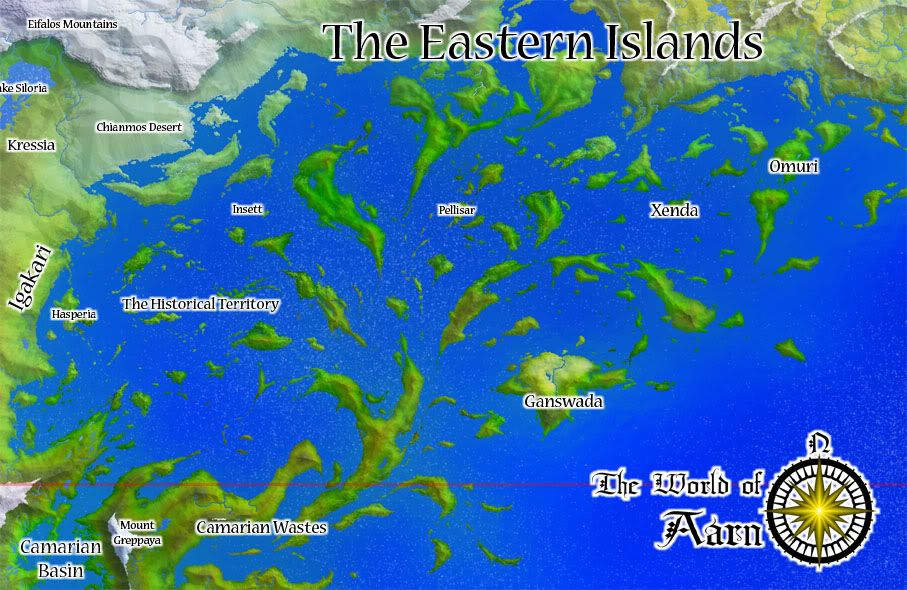
Summary: Unlike many other regions, the Eastern Islands do not have a single cohesive language, culture, or pantheon. The cultures of islands and islanders tend to be unique due to their isolation, and while many inhabitants of the Eastern Islands use boats and travel from island to island, just as many don't.
What can be said about the Eastern Islands is that they are the remnants of a land mass destroyed by a magical cataclysm, perpetrated by the first major human empire. The natives tend to be exotic and insular, the flora and fauna unique and wondrous, and the many ruins of the islands filled with magical treasures beyond imagining.
Regional Religion: Most inhabitants of the Eastern Islands are primitive and tribal, so it is no surprise that many native religions are animist in nature. Unlike other Aarnian religious followers, many island tribes do not even worship beings analogous to the gods of the mainland. Instead, the beings worshiped as gods include spirit animals, undead spirits and local fey. It has been theorized that the fey worshiped as gods have not yet become true gods because their worshipers are too few, or perhaps the scope of the fey abilities too small. Still, some mainland gods have been introduced to the islanders through missionaries, explorers and colonists. Igan gods are worshiped in the west, the gods of Camaria in the southwest, and the gods of Zhanpai in the north.
Naming styles: The natives of the Eastern Islands tend to have names that sound as if they were from islands in the Pacific and Indian oceans, including aboriginal Australia. This also includes a handful of languages centered more in and around mainland Asia, such as Japanese, Vietnamese and Korean.
As an important cultural note, the name that mainland humans have given to the humans from the Eastern Islands, “Kaipu,” is seen by many natives as a racial epithet. The root of the word “Kaipu” is related to the concept of “easterner” in some of the more common languages of the islands, and the islanders who understand the word find it insulting to be grouped under an all-inclusive label. They do not consider themselves the same race as the mainlanders from Zhanpai (also called Kaipu), nor do they even consider themselves the same race as those who live on their neighboring islands.
Major Islands and Cultures:
Omuri: This island nation is a matriarchal society that has a somewhat flexible caste system. One's caste is decided by many factors, including parentage, sex, and order of birth, but the most important factor deciding caste is the free will of the individual. There are approximately 20 castes in the society, and a child will normally be able to choose from two or three of these castes when he or she comes of age. Children in Honruka belong to no caste, and have no name. They are referred to by their family names, with diminutives, honorifics and context helping to tell siblings apart. It is not until their coming of age ceremonies that children will choose their name, similar to how they choose their caste. The island is famous for its warriors, quality metal smithing and its governing council of wise women.
Ganswada: One of the southernmost and largest of the Eastern Islands, Ganswada is cohabited by humans and centaurs who share a complex legal code. Because the cohabitation is homogeneous, neither side could form its own nation. Instead, members of each race have their own set of laws and social codes they must follow when dealing with members of their own race, and a separate set of of laws when working in mixed-race groups. Strangers to the island often find themselves bewildered when a human can pick a fight with a centaur with no legal consequence, and a centaur guard will arrest its own kind for picking a fight with a human, but not for picking a fight with its own kind.
Although Ganswada is quite far from the mainland, it is equidistant between the coastal kingdoms of Zhanpai, Camaria and Eastern Zenninfal, which has helped it become a politically neutral trading hub between all of the eastern nations and kingdoms. It is arguably the most politically and culturally important of the Eastern Islands, and international agreements are often brokered there.
Xenda: The neighbors of this small island watch it carefully, out of both caution and fear. 90% of the soil of Xenda is fertile and farm-grade. Farmed crops grow large and trees grow fast, which provides its inhabitants with a nearly inexhaustible supply of natural resources. The animals of the island are tough, hardy and ferocious in order to put up with the natural defenses of the quickly-growing plants. This competitiveness also applies to the humans who live on the island, who have begun to build fleets of primitive warships. Several islands have already been claimed through warfare and slavery, and the Xenda people are on the path to creating a vast empire.
The Historical Territory: This massive area has been claimed by Igakari, and is constantly patrolled by its powerful warships. Staying true to their supposedly diplomatic ways, the Igans do not concern themselves with the natives or natural resources of the area, and are simply interested in the Aledoran ruins. The official Igan doctrine is that the ruins are “Of great historical and cultural importance to the human race as a whole, and only the Great Nation of Igakari can be trusted to reveal the secrets of the ruins with an unbiased and apolitical eye.” In theory, Igan scholars were supposed to have an unobtrusive presence in the area. In practice, corrupt ship captains, shortsighted scholars and obsessively myopic archaeologists have all succeeded in making the lives of the natives miserable. Of course, the surrounding “civilized” kingdoms in the area do not trust Igakari at all, but currently have insufficient political or military capital to do anything about the claim but fume.
History: The history of the Eastern Islands of Aarn is a hopelessly tangled web of inter-island trading, constant wars, and commercialization attempts by mainlanders. It is much easier to find two historians who disagree about the Eastern Islands than who agree, though the islands themselves are extremely populars sources of research. There are scholars and sociologists who see the Eastern Islands as a model for the birth of civilization, and study the vast tangle of island politics closely. There are also archaeologists and wizards who explore the islands hoping to uncover the hidden secrets of the Aledorn people, despite (or perhaps because of) the mortal dangers associated with such research.
Magical Styles: The mages of the Easern Islands are overwhelmingly divine, with thousands of different casting methods. Some of the more exotic methods of casting include whistling, burning one's one flesh, acts of sexual depravity, eating sacred fruits, putting on masks and wearing animal skins, and making silly facial expressions.
There are very few wizards due to the lack of education, though there are a handful of tribes who practice wizardy in small amounts, in the same way an under-educated tribe of third-world natives might practice chemistry or electrical engineering.
Major Conflicts: If you throw a stone in the Eastern Islands, you'll hit a war or some kind of ethnic cleansing. Most of these wars are perpetrated by d'zonts or by humans. Centaurs are not comfortable on boats and ships, and their culture predisposes them to mostly keep to themselves. Ironically, the centaurs are the fiercest warriors of the islands; they have to be in order to survive without conquest.
Other troublemakers in the region include pirates, colonialists, missionaries, ornery dragons, mischievous spirit animals, opportunistic Ghorma who see the islands as a source of easily-stripped wealth, and ancient Aledoran horrors who still guard their temples and ruins ferociously.
Points of Interest
Pellisar: This island is a haven for pirates whose heritage consists of mainlanders of all colors and creeds. The pirates prey on the merchant ships who travel to and from the coastal mainland kingdoms. Most Aarn kingdoms consider Pellisar to be its own nation, though the pirates who live there see it less as a nation and more as a place of neutral ground for all pirate kind. Many wars have been declared against the island, but its easily defended coasts, natural resources and the sheer number of pirates calling it home have all worked against those who would like to see the Pirates' extinction. Pellisar is also the home of one of Aarn's largest slave trade operations, second only to the slave trade of the Valdrex themselves.
Hasperia: More a part of eastern Zenninfal culturally, Hasperia is an Igan colony close to the coastline. It is from this colony that Igakari conducts all of its business with the islands, including the managing of The Historical Territory.
Insett: This island is comically dangerous, and it is hailed as the most difficult place to survive in the world. It has practically no animal population, nor are there any permanent godtouched residents. Everything on the island is sharp, barbed, poisonous, or otherwise hazardous to the health of any and all seeking to explore it. It has been rumored that the island was originally the sight of an Aledoran biomancy lab, and its vegetative test subjects have overun the island over the thousands of years since the area became an island. An entire tourism industry has sprung up around the island, where foolhardy and suicidal adventurers attempt to “conquer” or “claim” the island for the sake of glory and prestige. In truth, everyone simply laughs at these adventurers for how stupid they are.
Assassins the world over see Insett as a mecca, and many travel to the island clandestinely to collect raw materials for their poisons.
Climate: The area covered by the Eastern Islands is massive, and covers a wide gamut between tropical, subtropical and occasionally temperate climes. Rain is plentiful, and only Ganswada has anything even approaching an arid climate. Unlike the mainland, much of the area is dominated by alternating seasons of hot, rainy, and cool weather. Beneath the waves, much of the continental plate has been shattered into cracks. In many places, pools of magma covering hundreds of square miles constantly bubble out of the ocean floor, making much of the area warmer and more stormy than it otherwise would be.
Native Godtouched: Ardlins (sea), Centaurs, Dragons (air, water, metal), D'zonts, Humans (Kaipu), Ghorma, Salamanders, Spirit Animals, Phoenixes.
Subscribe to:
Posts (Atom)
